>
Syngnathiformes (Pipefishes and seahorses) >
Centriscidae (Snipefishes and shrimpfishes) > Centriscinae
Etymology: Aeoliscus: Derived from Aeolius, region from Asia Minor and Aeolus, the Greek god of winds (Ref. 45335).
More on author: Günther.
Milieu: milieu / Klimaatzone / Diepte / verspreidingsgebied
Ecologie
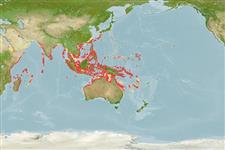
marien rifbewoner; diepte 2 - 42 m (Ref. 90102). Tropical; 32°N - 32°S, 38°E - 170°E
Indo-West Pacific: Tanzania (Ref. 51015) and Seychelles (Ref. 1623); then from southern Japan to New South Wales, Australia eastward to Vanuatu.
Grootte / Gewicht / Leeftijd
Maturiteit: Lm ? range ? - ? cm
Max length : 15.0 cm TL mannelijk / geslacht onbekend; (Ref. 1602)
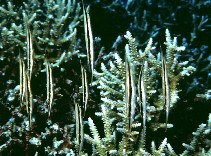
Dorsale stekels (totaal) : 3; Dorsale zachte stralen (totaal) : 9 - 10; Anale stekels: 0; Anale zachte stralen: 12. Recognized by hinged part of dorsal fin spine. Variable in color with habitat. Greenish-yellow with diffused stripe when in seagrass environment. Pale with black stripe when found on open substrate with white sand or rubble (Ref. 48635).
Body shape (shape guide): elongated; Cross section: compressed.
Form schools among the spines of Diadema or staghorn corals, and feed on minute crustaceans in the zooplankton. Remarkable for their strange body shape and swimming habit: the body is encased in an armor of thin, transparent plates; they swim in synchronized groups, each fish in a vertical position with the snout pointing downwards.
Levenscyclus en paargedrag
Maturiteit | Voortplanting | Paaien | Eieren | Fecunditeit | Larven
Myers, R.F., 1991. Micronesian reef fishes. Second Ed. Coral Graphics, Barrigada, Guam. 298 p. (Ref. 1602)
Status op de Rode Lijst van het IUCN (Ref. 130435: Version 2025-2 (Global))
Gevaar voor de mens
Harmless
Gebruik door de mens
Visserij: van geen belang; Aquarium: Commercieel
Tools
Speciale rapporten
Download XML
Internetbronnen
Schattingen op basis van modellen
Gewenste temperatuur (Ref.
123201): 25.2 - 29.3, mean 28.6 °C (based on 2830 cells).
Fylogenetische diversiteitsindex (Ref.
82804): PD
50 = 0.7502 [Uniqueness, from 0.5 = low to 2.0 = high].
Bayesian length-weight: a=0.00263 (0.00104 - 0.00666), b=3.10 (2.88 - 3.32), in cm total length, based on LWR estimates for this (Sub)family-body shape (Ref.
93245).
Trofisch niveau (Ref.
69278): 3.5 ±0.48 se; based on food items.
Weerstandsvermogen (Ref.
120179): Hoog, minimale populatieverdubbelingstijd minder dan 15 maanden (Preliminary K or Fecundity.).
Kwetsbaarheid van de visserij (Ref.
59153): Low vulnerability (10 of 100).
🛈
Voedingsstoffen (Ref.
124155): Calcium = 98.1 [55.6, 172.3] mg/100g; Iron = 0.802 [0.478, 1.329] mg/100g; Protein = 17.7 [16.5, 18.8] %; Omega3 = 0.119 [0.067, 0.212] g/100g; Selenium = 28 [15, 64] μg/100g; VitaminA = 191 [68, 523] μg/100g; Zinc = 1.5 [1.0, 2.1] mg/100g (wet weight);