>
Ovalentaria/misc (Various families in series Ovalentaria) >
Plesiopidae (Roundheads) > Acanthoclininae
Etymology: Acanthoplesiops: Greek, akantha = thorn + Greek, plesios = near + Greek, ops = similar (Ref. 45335); naka: Named for the first letters of the authors' childen's names, Nat, Nat, Aaron, Kelly, Adam.
Eponymy: The binomial is a construct from the first letters of the names of the two authors’ (Randall Mooi and Anthony Gill) four children: Aaron and Adam (Mooi) and Nat and Kelly (Gill). (Ref. 128868), visit book page.
More on authors: Mooi & Gill.
Entorno: milieu / zona climática / rango de profundidad / gama de distribución
Ecología
marino pelagic-neritic; rango de profundidad 21 - 32 m (Ref. 75897). Tropical
Eastern Central Pacific: Tonga.
Tamaño / Peso / Edad
Madurez: Lm ? range ? - ? cm
Max length : 1.0 cm SL macho / no sexado; (Ref. 75897)
Descripción breve
Claves de identificación | Morfología | Morfometría
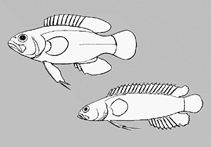
Espinas dorsales (total) : 18; Radios blandos dorsales (total) : 4; Espinas anales: 7; Radios blandos anales: 4; Vértebra: 27. This species is characterized by the following: D XVIII,4; anterior dorsal-fin pterygiophore formula ?/?/I+I/I/I/I/I/I/I//I/I/I/I; dentary pores 3; intertemporal pores 2, generally brownish head and body with darker pigment spots (from shrunken melanophores), except the pale stripe from the anterior half of the symphyseal flap to origin of dorsal fin continuous with a pale first dorsal spine, pectoral fin base with a pale spot, pale caudal peduncle continuous with pale bases of last 3 segmented dorsal- and anal-fin rays, the median fins slightly darker than body color with pale tips to their rays, first pelvic-fin ray dark on proximal 2/3 and pale on distal third, second pelvic-fin ray dark except for extreme distal tip; scales ctenoid; last dorsal- or anal-fin rays no membranous attachment to caudal fin (Ref. 75897).
Collected off a deep slope with a near vertical coral wall with a sandy channel at its base, followed by a steep drop-off (Ref. 75897). Eggs are guarded by the male parent (Ref. 205).
Ciclo vital y comportamiento de apareamiento
Madurez | Reproducción | Puesta | Huevos | Fecundidad | Larva
Eggs are guarded by the male parent (Ref. 205).
Mooi, R.D. and A.C. Gill, 2004. Description of a new species of the fish genus Acanthoplesiops Regan (Teleostei: Plesiopidae: Acanthoclininae) from Tonga. Zootaxa 432:1-10. (Ref. 75897)
Situación en la Lista Roja de la UICN (Ref. 130435: Version 2025-2 (Global))
Amenaza para el ser humano
Harmless
Usos humanos
Herramientas
Informes especiales
Descargar XML
Fuentes de Internet
Estimaciones basadas en modelos
Índice de diversidad filogenética (Referencia
82804): PD
50 = 0.5078 [Uniqueness, from 0.5 = low to 2.0 = high].
Bayesian length-weight: a=0.00468 (0.00181 - 0.01207), b=3.11 (2.88 - 3.34), in cm total length, based on LWR estimates for this (Sub)family-body shape (Ref.
93245).
Nivel trófico (Referencia
69278): 2.6 ±0.4 se; based on size and trophs of closest relatives
Resiliencia (Referencia
120179): Alto, población duplicada en un tiempo mínimo inferior a 15 meses (Preliminary K or Fecundity.).
Vulnerabilidad pesquera (Ref.
59153): Low vulnerability (10 of 100).
🛈