klasifikasi / Nama
Nama-nama umum | Sinonim (persamaan) | Catalog of Fishes(Marga, Jenis) | ITIS | CoL | WoRMS | Cloffa
>
Eupercaria/misc (Various families in series Eupercaria) >
Labridae (Wrasses) > Julidinae
Etymology: Halichoeres: Greek, als, alis = salt + Greek, choiros = pig (Ref. 45335); sazimai: Named for Dr. Ivan Sazima.
Eponymy: Professor Dr Ivan Sazima is a Brazilian ichthyologist, herpetologist, ornithologist and marine biologist. [...] (Ref. 128868), visit book page.
Lingkungan: lingkungan / zona iklim / kisaran kedalaman / jangkauan distribusi
Ekologi
laut pelagic-neritic; kisaran kedalaman 20 - 70 m (Ref. 80967). Tropical
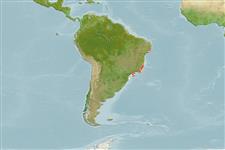
Southwest Atlantic: Brazil.
Ukuran / Berat / umur
Kematangan: Lm ? range ? - ? cm
Max length : 21.4 cm SL jantan/; (Ref. 80967)
deskripsi pendek
Kunci identifiaksi (pengenalan) | Morfologi | Morfometrik
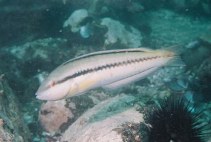
Duri punggung (Keseluruhan (total)) : 9; duri punggung lunak (Keseluruhan (total)) : 11; Duri dubur: 3; Sirip dubur lunak: 12; vertebrata, bertulang belakang: 24. This specie sis distinguished by the following characters: D IX,11; A III,12; pectoral rays 13; caudal rays 14; lateral line scales 27; body y white with a stripe running on midline of the body from the snout, through the eye to tail; stripe straight, broadest and continuous from the snout to the shoulder, when it turns into a line of close-set spots in a zigzag pattern in alternate scales of 2 adjoining rows; terminal phase have the stripe entirely black or black at the first half becoming brownish, some with golden spots above and below scales, body darkened in the dorsum and the abdomen, becoming grayish or greenish in the area just above the mid-body stripe to the base of the dorsal fin; at the initial phase, the stripe is brown on the first third of its length and yellow to golden on the last two thirds (Ref. 80967).
Body shape (shape guide): fusiform / normal.
Maximum depth from Ref. 126840. This species was observed foraging solitary on sand bottoms immediately adjacent to the lower end of rocky reefs. Harems that are composed of a few (5-10) individuals are not common but occasionally seen. This fish sometimes venture over the reefs, but generally never shallower than 20 m depth depending on water temperature (they seem to be associated with temperatures lower than 18°C). It also forages mostly on mobile invertebrates on soft and hard substratum, being more commonly observed foraging on sand bottoms and this behavior makes it a potential nuclear species in following associations, as it has been observed in other species of Halichoeres (Ref. 80967).
Siklus hidup dan perilaku kawin
Kematangan | Reproduksi, perkembang biakan | Pemijahan | telur-telur | Fekunditas | Larva
Distinct pairing during breeding (Ref. 205).
Luiz, O.J. Jr., C.E.L. Ferreira and L.A. Rocha, 2009. Halichoeres sazimai, a new species of wrasse (Perciformes: Labridae) from the Western South Atlantic. Zootaxa 2092:37-46. (Ref. 80967)
Status IUCN Red List (Ref. 130435: Version 2025-2 (Global))
ancaman kepada manusia
Harmless
penggunaan manusia
Alat, peralatan
laporan khas
muat turun XML
Sumber internet
Estimasi berdasarkan model
Suhu yang disukai (Acuan
123201): 21.6 - 27.2, mean 23.8 °C (based on 6 cells).
Indeks keanekaragaman filogenetik (Acuan
82804): PD
50 = 0.5000 [Uniqueness, from 0.5 = low to 2.0 = high].
Bayesian length-weight: a=0.01000 (0.00475 - 0.02106), b=3.09 (2.92 - 3.26), in cm total length, based on LWR estimates for this Genus-body shape (Ref.
93245).
Tingkat Trofik (Acuan
69278): 3.6 ±0.5 se; based on size and trophs of closest relatives
Daya lenting (Acuan
120179): sedang, Waktu penggandaan populasi minimum 1.4 - 4.4 tahun (Preliminary K or Fecundity.).
Kerentanan Penangkapan Ikan (Ref.
59153): Low vulnerability (16 of 100).
🛈