Classificatie / Namen
Lokale namen | Synoniemen | Catalog of Fishes(Genus, Soort(en)) | ITIS | CoL | WoRMS | Cloffa
>
Characiformes (Characins) >
Acestrorhamphidae (American tetras) > Acestrorhamphinae
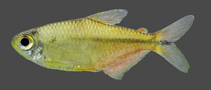
Etymology: Psalidodon: Greek, psalis, -idos = scissors + Greek, odous = teeth (Ref. 45335); vermilion: From the Latin word 'vermiculus' (small worm which yields a red dye), meaning an orangish red pigment, originally derived from the powdered mineral cinnabar. This is in allusion to the red coloration of posterior body portion of this species when alive.
Milieu: milieu / Klimaatzone / Diepte / verspreidingsgebied
Ecologie
; zoet water benthopelagisch. Tropical
South America: rio Salgado and rio Almada in Brazil.
Grootte / Gewicht / Leeftijd
Maturiteit: Lm ? range ? - ? cm
Max length : 4.3 cm SL mannelijk / geslacht onbekend; (Ref. 81202)
Korte beschrijving
Determinatiesleutels | Morfologie | Morfometrie
Dorsale zachte stralen (totaal) : 10 - 11; Anale zachte stralen: 23 - 26; Wervels: 33. Diagnosed from all its congeners from northeastern Brazilian drainages by having distal portion of pelvic fins dark, a combination of sexually dimorphic characters, posteroventral portion of body and fins (except pectoral) reddish in life, and inconspicuous humeral and caudal spots. Can be further distinguished by having the following characters: highest body depth just anterior of dorsal-fin origin, scales on lateral line 32-34; five series of scales between dorsal origin and lateral line; three series of scales between lateral line and pelvic-fin origin; anal fin with 20-23 branched rays; dorsal usually ii,8,i; base of anterior anal-fin rays with 8-12 scales; one or two maxillary teeth; presence of no more than 5 cusps and dentary teeth abruptly decreasing in size posteriorly (Ref. 81202).
Body shape (shape guide): fusiform / normal.
Inhabits clear water streams, running over rocky, pebbles and sand bottom at low altitudes ranging from 188 to 258 m, with slow to moderate water current and less than 1 m deep (Ref. 81202). Stomach contents of three specimens include filamentous algae, fragments of vascular plants and seeds, insects and other unidentified arthropods, and organic debris (Ref. 81202).
Levenscyclus en paargedrag
Maturiteit | Voortplanting | Paaien | Eieren | Fecunditeit | Larven
Zanata, A.M. and P. Camelier, 2009. Astyanax vermilion and Astyanax burgerai: a new characid fishes (Ostariophysi: Characiformes) from Northeastern Bahia, Brazil. Neotrop. Ichthyol. 7(2):175-184. (Ref. 81202)
Status op de Rode Lijst van het IUCN (Ref. 130435: Version 2025-2 (Global))
Gevaar voor de mens
Harmless
Gebruik door de mens
Tools
Speciale rapporten
Download XML
Internetbronnen
Schattingen op basis van modellen
Fylogenetische diversiteitsindex (Ref.
82804): PD
50 = 0.5000 [Uniqueness, from 0.5 = low to 2.0 = high].
Bayesian length-weight: a=0.01349 (0.00601 - 0.03026), b=3.09 (2.91 - 3.27), in cm total length, based on LWR estimates for this Genus-body shape (Ref.
93245).
Trofisch niveau (Ref.
69278): 3.0 ±0.3 se; based on size and trophs of closest relatives
Kwetsbaarheid van de visserij (Ref.
59153): Low vulnerability (10 of 100).
🛈