Classificazione / Nomi
Nomi Comuni | Sinonimi | Catalog of Fishes(Genere, Specie) | ITIS | CoL | WoRMS | Cloffa
Ambiente: milieu / zona climatica / distribuzione batimetrica / gamma di distribuzione
Ecologia
; acqua dolce demersale. Tropical
Asia: Pearl River drainage in Guangxi, China.
Dimensione / Peso / Età
Maturità: Lm ? range ? - ? cm
Max length : 7.2 cm SL maschio/sesso non determinato; (Ref. 80969)
Breve descrizione
Chiavi di identificazione | Morfologia | Morfometria
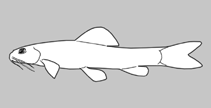
Raggi dorsali molli (totale) : 10; Raggi anali molli: 7. Can be differentiated from all other congeners of the Yunnanilus pleurotaenis group by the following characters: body completely covered by scales, except between pectoral fins and pelvic fins; lateral line with 15-20 pores; dorsal fin with 8 branched rays; pectoral fin with 13-14 branched rays; the air bladder with two chambers, the anterior ones into bony capsules and a large free posterior chamber, filling body cavity; caudal fin slightly emarginated; body depth 3.9-4.6 times the standard length (SL); head length 4.1-4.4 times SL; caudal peduncle depth 7.5-9.0 times SL; eye diameter 5.5-6.7 times the head length (HL); interorbital width 2.2-2.4 times HL (Ref. 80969).
Body shape (shape guide): elongated.
Ciclo vitale e comportamento di accoppiamento
Maturità | Riproduzione | Deposizione | Uova | Fecondità | Larve
Zhu, Y., Du L.-n., X.-y. Chen and J.-x. Yang, 2009. A new nemacheiline loach of genus Yunnanilus (Balitoridae) from Guangxi, China - Yunnanilus jinxiensis. Zool. Res. 30(2):195-198. (Ref. 80969)
Stato della Lista Rossa IUCN (Ref. 130435: Version 2025-2 (Global))
Minaccia per l'uomo
Harmless
Usi umani
Strumenti
Rapporti speciali
Scarica XML
Fonti Internet
Stime basate su modelli
Indice di diversità filogenetica (Fonte Biblio.
82804): PD
50 = 0.5000 [Uniqueness, from 0.5 = low to 2.0 = high].
Bayesian length-weight: a=0.00724 (0.00352 - 0.01491), b=3.01 (2.84 - 3.18), in cm total length, based on LWR estimates for this (Sub)family-body shape (Ref.
93245).
Livello trofico (Fonte Biblio.
69278): 3.1 ±0.3 se; based on size and trophs of closest relatives
Vulnerabilità della pesca (Ref.
59153): Low vulnerability (10 of 100).
🛈