klasifikasi / Nama
Nama-nama umum | Sinonim (persamaan) | Catalog of Fishes(Marga, Jenis) | ITIS | CoL | WoRMS | Cloffa
>
Gymnotiformes (Knifefishes) >
Hypopomidae (Bluntnose knifefishes)
Etymology: Brachyhypopomus: Greek, brachys, eia = short + Greek, hypo = under + Greek, poma, -atos = cover (Ref. 45335); gauderio: 'Gaudério', from the Brazilian folk traditions a synonym for 'gaúcho', meaning the person who lives in the countryside (pampas) of Rio Grande do Sul state, southern Brazil, Uruguay and Argentina, named in reference to the geographic distribution of the sp.
Lingkungan: lingkungan / zona iklim / kisaran kedalaman / jangkauan distribusi
Ekologi
; air tawar bentopelagis. Tropical; 29°S - 31°S, 49°W - 52°W
South America: Brazil, Uruguay and Paraguay. Brachyhypopomus gauderio is known from the Laguna dos Patos, Rio Uruguay and Rio Tramandaí drainages in the Rio Grande do Sul state, Brazil, being widely distributed from the central, southern and coastal regions of the state. It also occurs in the Rio Uruguay basin in Uruguay and in the Rio Paraguay basin in Paraguay (Ref. 80844).
Ukuran / Berat / umur
Kematangan: Lm ? range ? - ? cm
Max length : 14.9 cm SL jantan/; (Ref. 80844)
deskripsi pendek
Kunci identifiaksi (pengenalan) | Morfologi | Morfometrik
Duri punggung (Keseluruhan (total)) : 1 - 2; duri punggung lunak (Keseluruhan (total)) : 13 - 15; Duri dubur: 6 - 10; Sirip dubur lunak: 173 - 206. Head conical, nearly triangular in lateral view,
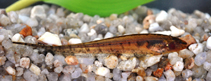
snout short and blunt, eyes small, mouth terminal with upper jaw length equal to lower jaw, no teeth in both jaws. Body laterally compressed. Dorsal profile convex from snout to caudal filament, most notably at anterior half of body. Ventral profile convex from lower jaw to anterior anal-fin base; nearly straight from that point to caudal filament. Highest body depth located at anal-fin origin. Body depth increasing from head to anal-fin origin, remaining nearly same depth to close to 40th anal-fin ray, sharply decreasing from that point to caudal filament. Caudal filament moderately short in all specimens; caudal filament slender and nearly cylindrical in females, juveniles and males in non-reproductive period; caudal filament vertically broadened and laterally compressed in sexually mature males. Cycloid scales covering body, except head and fins. Scales smaller on anterior portion of body; five to seven series of large scales along mid-lateral portion of body, reducing to two or three series posteriorly. Mid-lateral scales nearly twice larger than dorso-lateral and dorsal scales and four times larger in diameter than anterior ones; smallest scales covering region of anal-fin pterygiophores. First anterior perforated scale of lateral line above pectoral-fin origin; lateral line irregular, not extending to caudal filament. Branchial aperture small and slightly anterior to pectoral-fin origin. Pectoral fins rounded and with perpendicular insertion; pectoral-fin rays i–ii + 13–15 (15–17 total pectoral-fin rays, n=38, mode=16). Anal-fin relatively long with vi–x + 173–206 rays (180–216 total anal-fin rays, n=38, mode=198). Anal-fin origin located at same line of posterior edge of pectoral fin. Precaudal vertebrae 20–21 (18–19 anterior, 1–2 transitional; n=5). General body color varying from light brown to yellow. Head darker than rest of body. Dorsal surface with chocolate-brown stains that are connected forming reticulated drawing contrasting with yellow background. Variable number of brown stripes running from dorsal stains to base of anal fin, roughly defined in middle of body and occurring from head to tip of caudal filament. Anal and pectoral fins speckled with dark brown pigment, with hyaline inter-radial membranes. (Ref. 80844).
Body shape (shape guide): elongated; Cross section: compressed.
Facultative air-breathing in the genus (Ref. 126274)
Siklus hidup dan perilaku kawin
Kematangan | Reproduksi, perkembang biakan | Pemijahan | telur-telur | Fekunditas | Larva
Giora, J. and L.R. Malabarba, 2009. Brachyhypopomus gauderio, new species, a new example of underestimated species diversity of electric fishes in the southern South America (Gymnotiformes: Hypopomidae). Zootaxa 2093:60-68. (Ref. 80844)
Status IUCN Red List (Ref. 130435: Version 2025-2 (Global))
ancaman kepada manusia
Harmless
penggunaan manusia
Alat, peralatan
laporan khas
muat turun XML
Sumber internet
Estimasi berdasarkan model
Indeks keanekaragaman filogenetik (Acuan
82804): PD
50 = 0.5000 [Uniqueness, from 0.5 = low to 2.0 = high].
Bayesian length-weight: a=0.00372 (0.00141 - 0.00980), b=3.06 (2.83 - 3.29), in cm total length, based on LWR estimates for this (Sub)family-body shape (Ref.
93245).
Tingkat Trofik (Acuan
69278): 3.1 ±0.4 se; based on size and trophs of closest relatives
Kerentanan Penangkapan Ikan (Ref.
59153): Low vulnerability (10 of 100).
🛈