Classificazione / Nomi
Nomi Comuni | Sinonimi | Catalog of Fishes(Genere, Specie) | ITIS | CoL | WoRMS | Cloffa
>
Cichliformes (Cichlids, convict blennies) >
Cichlidae (Cichlids) > Pseudocrenilabrinae
Etymology: Melanochromis: Greek, melas, melanos = black + Greek, chromis = a fish, perhaps a perch (Ref. 45335); wochepa: The specific epithet, a noun in apposition, is derived from Chinyanja, the local language.
around the lake, and means “small” referring to the small adult size of this species.
Ambiente: milieu / zona climatica / distribuzione batimetrica / gamma di distribuzione
Ecologia
; acqua dolce benthopelagico. Tropical; 13°S - 14°S, 34°E - 35°E
Africa: endemic to lake Malawi (Ref. 80784, 89864)
Dimensione / Peso / Età
Maturità: Lm ? range ? - ? cm
Max length : 6.5 cm SL maschio/sesso non determinato; (Ref. 80784)
Breve descrizione
Chiavi di identificazione | Morfologia | Morfometria
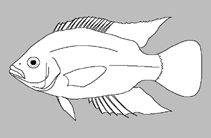
Melanochromis wochepa is distinguished from its congeners, except M. auratus, M. dialeptos, and M. mossambiquensis, by a steeper-angled vomer (72–80° vs. 35–53°). It is distinguished from M. auratus, M. dialeptos, and M. mossambiquensis by the male coloration pattern which is blue without white stripes and which is brown/black with yellow and pale-blue stripes in males of the other species. Female M. wochepa are distinguished from M. auratus by a submarginal dorsal band that is wider than the mid-lateral and the dorsolateral stripe. The abdominal yellow stripes in female M. wochepa are thin and never cover the entire lower abdomen, while those in female M. auratus usually cover the entire lower half of the body. M. wochepa is further distinguished from M. dialeptos by a longer head (30.2–33.3 vs. 29.8–31.4 % SL), a deeper body (30.2–34.7 vs. 26.8–31.8 % SL), by a larger distance between the posterior dorsal and pelvic fin (53.3–59.8 % vs. 49.8–55.8 % SL), by a longer pectoral fin (22.8–33.0 % vs. 19.5–24.3 % SL), and by more dorsal-fin rays(7–10 (mode 9) vs. 7–9 (mode 7)). It is further distinguished from M. mossambiquensis by a deeper body as expressed in a larger distance between the origins of the dorsal and anal fins (49.6–54.5 % vs. 47.1–50.8 % SL) and a larger distance between the origins of the dorsal and pelvic fins (30.1–36.4 % vs. 27.6–33.4 % SL), and by a shorter lower jaw (26.7–32.5 % vs. 29.0–41.5 % HL).
Body shape (shape guide): fusiform / normal.
Occurs in shallow, rocky habitat; mostly seen solitary; not uncommon; males do not defend territory, but displays between males are frequent and short of duration; feeds from aufwuchs on rocks from which it picks algal strands and diatoms (Ref. 80784).
Ciclo vitale e comportamento di accoppiamento
Maturità | Riproduzione | Deposizione | Uova | Fecondità | Larve
Konings-Dudin, G, A.F. Konings and J.R. Stauffer Jr., 2009. Descriptions of three new species of Melanochromis (Teleostei: Cichlidae) and a redescription of M. vermivorus. Zootaxa 2076:37-59. (Ref. 80784)
Stato della Lista Rossa IUCN (Ref. 130435: Version 2025-2 (Global))
Minaccia per l'uomo
Harmless
Usi umani
Strumenti
Rapporti speciali
Scarica XML
Fonti Internet
Stime basate su modelli
Indice di diversità filogenetica (Fonte Biblio.
82804): PD
50 = 0.5000 [Uniqueness, from 0.5 = low to 2.0 = high].
Bayesian length-weight: a=0.01445 (0.00671 - 0.03113), b=2.99 (2.82 - 3.16), in cm total length, based on LWR estimates for this (Sub)family-body shape (Ref.
93245).
Livello trofico (Fonte Biblio.
69278): 3.3 ±0.4 se; based on size and trophs of closest relatives
Vulnerabilità della pesca (Ref.
59153): Low vulnerability (10 of 100).
🛈