Milieu: milieu / Klimaatzone / Diepte / verspreidingsgebied
Ecologie
marien pelagic-neritic; diepte ? - 450 m (Ref. 36731). Tropical
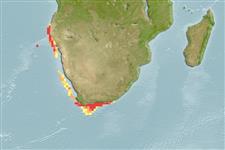
Southeast Atlantic: South Africa and Namibia.
Lengte bij maturiteit / Grootte / Gewicht / Leeftijd
Maturiteit: Lm 9.5 range ? - ? cm
Max length : 17.0 cm SL mannelijk / geslacht onbekend; (Ref. 36731)
Korte beschrijving
Determinatiesleutels | Morfologie | Morfometrie
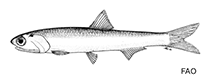
Diagnosis: It hardly differs from the European anchovy (Engraulis encrasicolus); of other anchovies in southern and eastern African waters, species of Stolephorus have 3 to 7 sharp needle-like scutes along the belly, while species of Thryssa have compressed bodies and a keel of scutes along the belly (Ref. 189).
Body shape (shape guide): elongated.
Pelagic in coastal waters, but down to a depth of about 400 m (Ref. 30573). It feeds on planktonic organisms (Ref. 30573). Larvae and juveniles were observed to be selective, raptorial carnivores and switched to non-selective filter feeding omnivory when adults. Caught with purse seines in South Africa and Namibia (Ref. 80687).
Levenscyclus en paargedrag
Maturiteit | Voortplanting | Paaien | Eieren | Fecunditeit | Larven
Bianchi, G., K.E. Carpenter, J.-P. Roux, F.J. Molloy, D. Boyer and H.J. Boyer, 1999. FAO species identification guide for fishery purposes. Field guide to the living marine resources of Namibia. FAO, Rome. 265 p. (Ref. 36731)
Status op de Rode Lijst van het IUCN (Ref. 130435: Version 2025-2 (Global))
Gevaar voor de mens
Harmless
Gebruik door de mens
Visserij: commercieel
Tools
Speciale rapporten
Download XML
Internetbronnen
Schattingen op basis van modellen
Gewenste temperatuur (Ref.
123201): 10.2 - 16.7, mean 13.7 °C (based on 40 cells).
Fylogenetische diversiteitsindex (Ref.
82804): PD
50 = 0.5020 [Uniqueness, from 0.5 = low to 2.0 = high].
Bayesian length-weight: a=0.00457 (0.00211 - 0.00989), b=3.13 (2.96 - 3.30), in cm total length, based on LWR estimates for this Genus-body shape (Ref.
93245).
Trofisch niveau (Ref.
69278): 3.0 ±0.1 se; based on size and trophs of closest relatives
Generation time: 1.2 ( na - na) years. Estimated as median ln(3)/K based on 1
growth studies.
Weerstandsvermogen (Ref.
120179): Hoog, minimale populatieverdubbelingstijd minder dan 15 maanden (Preliminary K or Fecundity.).
Prior r = 0.42, 95% CL = 0.28 - 0.64, Based on 2 full stock assessments.
Kwetsbaarheid van de visserij (Ref.
59153): Low vulnerability (11 of 100).
🛈
Kwetsbaarheid voor het klimaat (Ref.
125649): Low to moderate vulnerability (26 of 100).
🛈
Voedingsstoffen (Ref.
124155): Calcium = 347 [143, 896] mg/100g; Iron = 1.54 [0.71, 3.72] mg/100g; Protein = 17.9 [16.6, 19.3] %; Omega3 = 0.625 [0.326, 1.241] g/100g; Selenium = 50.5 [20.5, 129.2] μg/100g; VitaminA = 19.5 [4.1, 89.8] μg/100g; Zinc = 1.66 [0.99, 2.78] mg/100g (wet weight);