Ταξινόμηση / Ονόματα
Κοινά ονόματα | Συνώνυμα | Catalog of Fishes(Γένος, Είδη) | ITIS | CoL | WoRMS | Cloffa
>
Blenniiformes (Blennies) >
Blenniidae (Combtooth blennies) > Salariinae
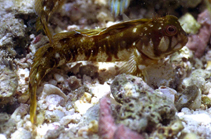
Etymology: itajobi: The name signifies 'green stone or emerald' (ita = stone; jobi =green) in 'Tupi', a native South-American language; refers to the emerald-green color of the species and an allusion to its type locality known as 'The Emerald of Atlantic'.
Περιβάλλον: περιβάλλον / κλιματική ζώνη / εύρος βάθους / εύρος διανομής
Οικολογία
Θαλασσινό(ά) βενθικό(ς). Tropical; 3°S - 4°S, 32°W - 33°W
Atlantic Ocean, Western South: Fernando de Noronha Archipelago, a volcanic island located 345km off northeastern Brazil. Considered as endemic of the Noronha-Rocas island complex (Ref. 80496).
Μέγεθος / Βάρος / Ηλικία
Γεννητική Ωρίμανση: Lm ? range ? - ? cm
Max length : 4.7 cm SL αρσενικό/απροσδιόριστο; (Ref. 80496)
Σύντομη περιγραφή
Κλείδες προσδιορισμού | Μορφολογία | Μορφομετρία
Ραχιαίες άκανθες (συνολικά) : 12; Μαλακές ραχιαίες ακτίνες (συνολικά) : 13 - 15; Εδρικές άκανθες: 2; Μαλακές εδρικές ακτίνες: 15 - 16. Distinguished from its Atlantic congeners by the following combination of characters: a small blue spot on the 2nd dorsal spine (noted mainly in adult males), head with tiny black spots (vs. speckles absent in Scartella cristata), modally 14 segmented dorsal-fin rays (vs. 15 in S. cristata from Brazilian localities, S. caboverdiana, and S. nuchifilis; and 16 in S. springeri), modally 15
segmented anal-fin rays (vs. 16 in S. poiti, 17 in S. cristata from Brazilian localities, S. caboverdiana, and S. nuchifilis; and 18 in S. springeri), and modally 23 caudal vertebrae (vs. 24 in S. cristata from other Brazilian
localities, S. caboverdiana, and S. nuchifilis; and 25 in S. springeri) (Ref. 80496).
Body shape (shape guide): fusiform / normal.
Collected in shallow-waters and tide pools of the type locality. Similar to its congeners, this species is extremely tolerant to salinity and temperature variations. Some individuals were
also found in small crevices of emerged rocks (2 meters above sea surface), remaining up to 20 minutes out of the water, probably avoiding predators. (Ref. 80496). Similar to its congeners, this species is oviparous. Eggs are demersal and adhesive (Ref. 205), and are attached to the substrate via a filamentous, adhesive pad or pedestal (Ref. 94114). Larvae are planktonic, often found in shallow, coastal waters (Ref. 94114).
Κύκλος ζωής και συμπεριφορά ζευγαρώματος
Γεννητική Ωρίμανση | Αναπαραγωγή | Γεννοβολία | Αβγά | Γονιμότητα | Προνύμφες
Oviparous, distinct pairing (Ref. 205).
Rangel, C.A. and L.F. Mendes, 2009. Review of blenniid fishes from Fernando de Noronha Archipelago, Brazil, with description of a new species of Scartella (Teleostei: Blenniidae). Zootaxa 2006:51-61. (Ref. 80496)
Κατάσταση Κόκκινου Καταλόγου IUCN (Ref. 130435: Version 2025-2 (Global))
Απειλή για τον άνθρωπο
Harmless
Ανθρώπινες χρήσεις
Εργαλεία
Ειδικές εκθέσεις
Λήψη XML
Διαδικτυακές πηγές
Εκτιμήσεις βάσει μοντέλων
Δείκτης φυλογενετικής ποικιλότητας (Αναφ.
82804): PD
50 = 0.5078 [Uniqueness, from 0.5 = low to 2.0 = high].
Bayesian length-weight: a=0.01047 (0.00463 - 0.02370), b=2.98 (2.79 - 3.17), in cm total length, based on LWR estimates for this (Sub)family-body shape (Ref.
93245).
Τροφικό Επίπεδο (Αναφ.
69278): 2.8 ±0.3 se; based on size and trophs of closest relatives
Ελαστικότητα (Αναφ.
120179): Υψηλό, ελάχιστος χρόνος για διπλασιασμό πληθυσμού < 15 μήνες (Preliminary K or Fecundity.).
Ευπάθεια στην αλιεία (Ref.
59153): Low vulnerability (10 of 100).
🛈