>
Lophiiformes (Anglerfishes) >
Histiophrynidae (Starfingered frogfishes)
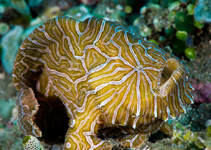
Etymology: Histiophryne: Greek, istion, istos = sail + Greek, phryne = toad (Ref. 45335); psychedelica: Named for the unique pigment pattern of swirling concentric rings and stripes covering the head, body, and fins.
Ambiente: milieu / zona climática / intervalo de profundidade / gama de distribuição
Ecologia
marinhas demersal; intervalo de profundidade 5 - 10 m (Ref. 90102). Tropical
Distribuição
Territórios | Áreas FAO | Ecossistemas | Ocorrências | Mapa dos pontos | Introduções | Faunafri
Western Pacific: Indonesia.
Tamanho / Peso / Idade
Maturidade: Lm ? range ? - ? cm
Max length : 6.5 cm SL macho/indeterminado; (Ref. 80493); 8.7 cm SL (female)
Descrição breve
Chaves de identificação | Morfologia | Morfometria
Espinhos dorsais (total) : 3; Raios dorsais moles (total) : 13; Raios anais moles: 7; Vértebras: 20. This species is unique in having a broad flat face, surrounded by thick, fleshy, laterally expanded cheeks and chin, with eyes directed anteriorly; body skin thick and loose, forming conspicuous fleshy folds that envelop the unpaired fins; a pigment pattern of white stripes runs from the eyes and continuing back to the body and tip of the caudal fin; genetic divergence in the nuclear recombination activation gene-2 (RAG2), cytochrome oxidase-I (COI), and 16S rRNA genes (Ref. 80493).
Body shape (shape guide): short and / or deep; Cross section: compressed.
This species was found at a depth of 5-7 m, within 100 m of the commercial jetty in the harbor at Ambon City (its type locality that was previously well known to divers as the ‘‘Twilight Zone,’’ because of the presence of many rare animals); currents varied from virtually nonexistent to strong; visibility varied between about 10 and 30 m; sea floor in this location slopes gently near shore, but more steeply below 10 m, quickly reaching a depth of 100 m or more; aside from the coral rubble, the bottom was littered with a variety of human refuse; and both individuals were consistently found hidden among coarse coral rubble, usually encrusted with ascidians, sponges, and coralline algae (Ref. 80493).
Ciclo de vida e comportamento de acasalamento
Maturidade | Reprodução | Desova | Ovos | Fecundidade | Larvas
Pietsch, T.W., R.J. Arnold and D.J. Hall, 2009. A bizarre new species of frogfish of the genus Histiophryne (Lophiiformes: Antennariidae) from Ambon and Bali, Indonesia. Copeia 2009(1):37-45. (Ref. 80493)
Categoria na Lista Vermelha da IUCN (Ref. 130435: Version 2025-2 (Global))
Ameaça para o homem
Harmless
Utilização humana
Ferramentas
Relatórios especiais
Descarregue XML
Fontes da internet
Estimativas baseadas em modelos
Índice de diversidade filogenética (Ref.
82804): PD
50 = 0.5313 [Uniqueness, from 0.5 = low to 2.0 = high].
Bayesian length-weight: a=0.01995 (0.00906 - 0.04395), b=3.01 (2.83 - 3.19), in cm total length, based on all LWR estimates for this body shape (Ref.
93245).
Nível Trófico (Ref.
69278): 3.7 ±0.5 se; based on size and trophs of closest relatives
Resiliência (Ref.
120179): Elevada, tempo mínimo de duplicação da população menor que 15 meses (Fec assumed to be > 10,000).
Vulnerabilidade da pesca (Ref.
59153): Low vulnerability (10 of 100).
🛈