Klassifizierung / Names
Namen | Synonyme | Catalog of Fishes(Gattung, Arten) | ITIS | CoL | WoRMS | Cloffa
>
Stomiiformes (Lightfishes and dragonfishes) >
Stomiidae (Barbeled dragonfishes) > Malacosteinae
Etymology: Photostomias: Greek, photos = light + greek, stoma = mouth (Ref. 45335); tantillux: Name from Latin 'tantillus' for ‘so little’ or ‘so small’ and 'lux' for ‘light’, referring to the small size of the light-producing postorbital of this species.
Umwelt: Milieu / Klimazone / Tiefenbereich / Verbreitungsgebiet
Ökologie
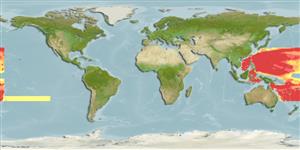
seewasser bathypelagisch; tiefenbereich 1138 - 3100 m (Ref. 86942). Deep-water; 33°N - 31°S
Pacific Ocean: tropical and subtropical; from off Skikoko, Japan, to the eastern South Pacific.
Größe / Gewicht / Alter
Geschlechtsreife: Lm ? range ? - ? cm
Max length : 10.1 cm SL Männchen/unbestimmt; (Ref. 80463); 8.5 cm SL (female)
Kurzbeschreibung
Bestimmungsschlüssel | Morphologie | Morphometrie
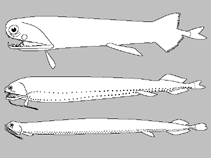
This species differs from its congeners in having the following set of characters: postorbital photophore (PO) small in males greater than 60 mm, 12.1- 20.0% upper jaw length (UJL) (vs. moderate to large, 21.0-46.6% UJL, in P. atrox, P. liemi, and P. lucingens; female PO small, 7.9-10.8% UJL (vs. moderate to large, 9.4-18.9% UJL, in all other species of Photostomias except P. guernei; accessory orbital (AO) small to moderate in males greater than 60 mm, 2.1-7.4% UJL (vs. small, 2.4-4.7% UJL, in P. lucingens); females maturing (ova > 0.2 mm) at approximately 70 mm (vs. 100 mm in P. atrox and P. liemi); three tooth patches at posterior end of the first, second, and third basibranchials (vs. 2 basibranchial tooth patches in P. guernei); total of dorsal- and anal-fin rays 48-52, rarely 53 (vs. 57-63, rarely 56, in P. goodyeari) (Ref. 80463).
Body shape (shape guide): elongated.
Lebenszyklus und Paarungsverhalten
Geschlechtsreife | Fortpflanzung | Ablaichen | Eier | Fruchtbarkeit | Larven
Kenaley, C.P., 2009. Revision of Indo-Pacific species of the loosejaw dragonfish genus Photostomias (Teleostei: Stomiidae: Malacosteinae). Copeia 2009(1):175-189. (Ref. 80463)
IUCN Rote Liste Status (Ref. 130435: Version 2025-2 (Global))
Bedrohung für Menschen
Harmless
Nutzung durch Menschen
Fischereien: nicht kommerziell
Tools
Zusatzinformationen
Download XML
Internet Quellen
Schätzungen auf der Grundlage von Modellen
Bevorzugte Temperatur (Ref.
123201): 2.2 - 3.4, mean 2.7 °C (based on 491 cells).
Phylogenetischer Diversitätsindex (Ref.
82804): PD
50 = 0.5156 [Uniqueness, from 0.5 = low to 2.0 = high].
Bayesian length-weight: a=0.00407 (0.00160 - 0.01037), b=3.10 (2.87 - 3.33), in cm total length, based on LWR estimates for this (Sub)family-body shape (Ref.
93245).
Trophische Ebene (Ref.
69278): 3.8 ±0.6 se; based on size and trophs of closest relatives
Widerstandsfähigkeit (Ref.
120179): hoch, Verdopplung der Population dauert weniger als 15 Monate. (Preliminary K or Fecundity.).
Anfälligkeit der Fischerei (Ref.
59153): Low vulnerability (10 of 100).
🛈