Clasificación / Nombres
Nombres comunes | Sinónimos | Catalog of Fishes(Género, Especie) | ITIS | CoL | WoRMS | Cloffa
>
Siluriformes (Catfishes) >
Trichomycteridae (Pencil or parasitic catfishes) > Trichomycterinae
Etymology: Trichomycterus: Greek, thrix = hair + Greek, mykter, -eros = nose (Ref. 45335).
More on authors: Fernández & Vari.
Entorno: milieu / zona climática / rango de profundidad / gama de distribución
Ecología
; agua dulce bentopelágico. Tropical
South America: Argentina.
Tamaño / Peso / Edad
Madurez: Lm ? range ? - ? cm
Max length : 6.9 cm SL macho / no sexado; (Ref. 80457)
Descripción breve
Claves de identificación | Morfología | Morfometría
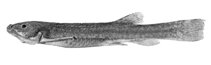
Radios blandos dorsales (total) : 14 - 16; Radios blandos anales: 10 - 11; Vértebra: 33 - 34. This species is distinguished from its congeners, with the exception of T. areolatus by having a relatively low number of odontodes 1-14 (vs. 16 or more) on the opercle (apparent in cleared-and-stained specimens and on the interopercle 2-20 (vs. 28-40), and by the extent of development of the integument on the interopercle (integument thin and not enveloping odontodes on the interopercle vs. integument thick with odontodes embedded in integument
other than in smaller individuals). This new species differs from T. areolatus by the number of total vertebrae 33-34 (vs. 37- 39); the area of insertion of the first proximal dorsal-fin pterygiophore is posterior to neural spine of vertebra 16 or 17 (vs. vertebrae 20-22); supraorbital canal segment and pore So3 continuous, with pore So3 absent (vs. discontinuous with pore So3 present); the papillae-like structures on the body present (vs. absent). It is further distinguished from all congeners, with the exception of T. corduvensis from
Argentina and T. therma and T. tiraquae from Bolivia, by the its possession of elongate premaxillary teeth with the distal portion of each tooth flattened and slightly expanded; presence of papillae-like structures on the body; continuous supraorbital canal within the frontal with the presence of a segment between pores So2 and So6 (but with pore So3 missing); long lateral line canal with 4 pores. Also if differs with its congeners in the caudal peduncle depth 8.4-11.3% SL (vs. 11.9-13.2% SL in T. corduvensis); in head width 19.1-21.8% SL (vs. 17.4-19.0% SL in T. tiraquae ) and nearly completely in the distance from the tip of the snout to the insertion of the pelvic fin 57.4-61.9% SL (vs. 56.6-57.6% SL in T. tiraquae); in the degree of development of the transverse skin on the ventral surface of the head not thickened (vs. distinctly thickened in T. therma) (Ref. 80457).
Inhabits a small, clear water stream that flows down a small rocky canyon into a small pool. Stream and pool depth range, approximately 0.2 to 0.6 m deep and 1.0 to 1.5 m wide; both had rock and pebble bottoms and with limited adjoining terrestrial vegetation among the surrounding boulders. The type locality (Río Hualco) seeps into the soil downstream from the pool and is apparently isolated from adjoining drainages throughout the year. The specimens were collected both above and below an approximately three-meter high waterfall within the stream and in the pool, none were observed in the small outflow stream that drains the pool. Stomach contents include dipteran larvae (Chironomidae and Ceratopogonidae), this diet of autochthonous benthic macroinvertebrates is common to species of Trichomycterus. T. alterus was also collected from this site. Local inhabitants utilize the Río Hualco as a recreation site and on occasion as a bathing area, hence such activities put it at risk of ecological alteration, a threat common to many other aquatic habitats within those portions of the Andes especially for this species, given its apparent restriction to that small drainage system (Ref. 80457).
Ciclo vital y comportamiento de apareamiento
Madurez | Reproducción | Puesta | Huevos | Fecundidad | Larva
Fernández, L. and R.P. Vari, 2009. New species of Trichomycterus from the Andean Cordillera of Argentina (Siluriformes: Trichomycteridae). Copeia 2009(1):195-202. (Ref. 80457)
Situación en la Lista Roja de la UICN (Ref. 130435: Version 2025-2 (Global))
Amenaza para el ser humano
Harmless
Usos humanos
Pesquerías: sin interés
Herramientas
Informes especiales
Descargar XML
Fuentes de Internet
Estimaciones basadas en modelos
Índice de diversidad filogenética (Referencia
82804): PD
50 = 0.5000 [Uniqueness, from 0.5 = low to 2.0 = high].
Bayesian length-weight: a=0.00912 (0.00396 - 0.02102), b=2.97 (2.79 - 3.15), in cm total length, based on LWR estimates for this Genus-body shape (Ref.
93245).
Nivel trófico (Referencia
69278): 3.2 ±0.4 se; based on size and trophs of closest relatives
Vulnerabilidad pesquera (Ref.
59153): Low vulnerability (10 of 100).
🛈