Classificazione / Nomi
Nomi Comuni | Sinonimi | Catalog of Fishes(Genere, Specie) | ITIS | CoL | WoRMS | Cloffa
>
Ophidiiformes (Cusk eels) >
Bythitidae (Livebearing brotulas)
Etymology: cryptica: The specific name, cryptica, refers to its hidden nature (Ref. 80456).
Eponymy: Cristoforo Bellotti (1823–1919) was an Italian ichthyologist and palaeontologist, who was also very interested in the breeding of silkworms. [...] (Ref. 128868), visit book page.
More on authors: Nielsen, Ross & Cohen.
Ambiente: milieu / zona climatica / distribuzione batimetrica / gamma di distribuzione
Ecologia
marino benthopelagico, usually 629 - ? m (Ref. 80456). Subtropical; 31°N - 30°N, 79°W - 80°W
Atlantic Ocean: USA.
Dimensione / Peso / Età
Maturità: Lm ? range ? - ? cm
Max length : 4.2 cm SL maschio/sesso non determinato; (Ref. 80456)
Breve descrizione
Chiavi di identificazione | Morfologia | Morfometria
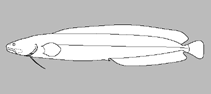
Raggi dorsali molli (totale) : 92; Raggi anali molli: 84; Vertebre: 49. Bellottia cryptica differs from its congeners by the following combination of characters: body slender (17.0% SL at origin of anal fin), teeth small and pointed, caudal fin rays 7, origin of anal fin below dorsal fin ray 8, anterior gill arch with 5 long rakers, predorsal length 46.5% SL, precaudal vertebrae 10, cleithrum with distinct spine just above base of pectoral fin, no spine on preopercular crest (Ref. 80456).
Body short, highest near base of pectoral fin, completely covered with oval ca. 0.7mm cycloid scales. Lateral line indistinct with anterior part apparently near dorsal margin of body. Head profile convex, cheekand gill cover scaled with rest of head naked. Mouth oblique with posterior part of maxilla vertically expanded ending just behind eye. Anterior nostril with low rim placed closer to upper lip than to posterior nostril. Small opercular spine strong and pointed, reaching beyond posterior margin of opercle. Lower edge of preopercle with 4 distinct spines, and no spine on preopercular crest. Origin of dorsal fin above tip of pectoral fin, anal fin origin at midpoint of fish. Pectoral fin placed on mid-body level with peduncle higher than long. A prominent spine on cleithrum just above base of pectoral fin. Anterior gill arch with 3–4 platelike rakers on upper branch, one long raker in the angle between the two branches and lower branch with 4–5 long rakers followed by 8–9 plate-like rakers. Longest gill filament about 1/3 of longest raker. Two short, broad pseudobranchial filaments. Head pores: the following large, distinct pores were observed: three behind and three below the eye and four pores on the mandible. A few whitish sensory papillae distributed over the head (Ref. 80456).
Body shape (shape guide): short and / or deep.
Ciclo vitale e comportamento di accoppiamento
Maturità | Riproduzione | Deposizione | Uova | Fecondità | Larve
Nielsen, J.G., S.W. Ross and D.M. Cohen, 2009. Atlantic occurrence of the genus Bellottia (Teleostei, Bythitidae) with two new species from the Western North Atlantic. Zootaxa 2018:45-57. (Ref. 80456)
Stato della Lista Rossa IUCN (Ref. 130435: Version 2025-2 (Global))
Minaccia per l'uomo
Harmless
Usi umani
Strumenti
Rapporti speciali
Scarica XML
Fonti Internet
Stime basate su modelli
Indice di diversità filogenetica (Fonte Biblio.
82804): PD
50 = 0.5312 [Uniqueness, from 0.5 = low to 2.0 = high].
Bayesian length-weight: a=0.01995 (0.00906 - 0.04395), b=3.01 (2.83 - 3.19), in cm total length, based on all LWR estimates for this body shape (Ref.
93245).
Livello trofico (Fonte Biblio.
69278): 3.2 ±0.5 se; based on size and trophs of closest relatives
Resilienza (Fonte Biblio.
120179): Alto, tempo minimo di raddoppiamento della popolazione meno di 15 mesi (Preliminary K or Fecundity.).
Vulnerabilità della pesca (Ref.
59153): Low vulnerability (10 of 100).
🛈