>
Cypriniformes (Carps) >
Cyprinidae (Minnows or carps) > Barbinae
Etymology: Barbus: Latin, barbus = barbel (Ref. 45335); niluferensis: Named for its type locality.
Eponymy: Sir Charles Alfred Payton (1843–1926) was a British adventurer, writer, fisherman and diplomat who was British Consul to Morocco, where this barb is found. [...] (Ref. 128868), visit book page.
More on authors: Turan, Kottelat & Ekmekçi.
Entorno: milieu / zona climática / rango de profundidad / gama de distribución
Ecología
; agua dulce pelágico. Subtropical
Asia: Turkey.
Tamaño / Peso / Edad
Madurez: Lm ? range ? - ? cm
Max length : 14.6 cm SL macho / no sexado; (Ref. 80049)
Descripción breve
Claves de identificación | Morfología | Morfometría
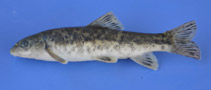
Vértebra: 43 - 44. This species is distinguished from its congeners in Turkey and the Aegean basin by possessing a less strongly ossified last simple dorsal-fin ray and with fewer serrae along the proximal part of its posterior margin (serrated along 49-52 % of its length, vs. 56-77; 15-17 serrae, vs. 18-32) and having fewer gill rakers on the first gill arch (6-8, modally 8, vs. 7-14, modally 9-11 in the different species). It is further distinct with the following characters (none unique to the species): a small size (largest known specimen 14.6 cm SL); a short caudal fin (15.7-20.4 % SL); large and many irregular black spots on the back, as well as on the fins and flank, and small black spots on the head, extending downwards to the cheek; fleshy lips; lateral line scales 62-71; scale rows between the lateral line and the dorsal-fin origin 13-15 and between the lateral line and the anal-fin origin 8-10; last simple dorsal-fin ray weakly ossified; body depth at dorsal-fin origin 17.2-22.4 % SL; head length 23.3-25.7 % SL (Ref. 80049).
Body shape (shape guide): elongated; Cross section: compressed.
Occurs in swift flowing water, with cobble and pebble bottom (Ref. 80049).
Ciclo vital y comportamiento de apareamiento
Madurez | Reproducción | Puesta | Huevos | Fecundidad | Larva
Turan, D., M. Kottelat and F. Güler Ekmekçi, 2009. Barbus niluferensis, a new species of barbel (Teleostei: Cyprinidae) from Nilüfer River, Turkey, with re-description of B. oligolepis. Zootaxa 1981:15-28. (Ref. 80049)
Situación en la Lista Roja de la UICN (Ref. 130435: Version 2025-2 (Global))
Amenaza para el ser humano
Harmless
Usos humanos
Herramientas
Informes especiales
Descargar XML
Fuentes de Internet
Estimaciones basadas en modelos
Índice de diversidad filogenética (Referencia
82804): PD
50 = 0.5000 [Uniqueness, from 0.5 = low to 2.0 = high].
Bayesian length-weight: a=0.00794 (0.00367 - 0.01719), b=3.05 (2.88 - 3.22), in cm total length, based on LWR estimates for this Genus-body shape (Ref.
93245).
Nivel trófico (Referencia
69278): 3.1 ±0.4 se; based on size and trophs of closest relatives
Resiliencia (Referencia
120179): Alto, población duplicada en un tiempo mínimo inferior a 15 meses (Preliminary K or Fecundity.).
Vulnerabilidad pesquera (Ref.
59153): Low vulnerability (10 of 100).
🛈