Classificazione / Nomi
Nomi Comuni | Sinonimi | Catalog of Fishes(Genere, Specie) | ITIS | CoL | WoRMS | Cloffa
>
Atheriniformes (Silversides) >
Melanotaeniidae (Rainbowfishes, blue eyes)
Etymology: Melanotaenia: Greek, melan, -anos = black + latin, taenia = stripe (Ref. 45335); kokasensis: Named for the nearby village of Kokas, which is the major landmark in the area.
Ambiente: milieu / zona climatica / distribuzione batimetrica / gamma di distribuzione
Ecologia
; acqua dolce pelagico. Tropical
Asia: Indonesia.
Dimensione / Peso / Età
Maturità: Lm ? range ? - ? cm
Max length : 6.9 cm SL maschio/sesso non determinato; (Ref. 79630); 5.9 cm SL (female)
Breve descrizione
Chiavi di identificazione | Morfologia | Morfometria
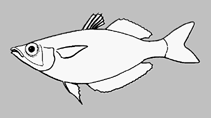
Spine dorsali (totale) : 5 - 6; Raggi dorsali molli (totale) : 11 - 14; Spine anali: 1; Raggi anali molli: 21 - 24. This species is distinguished by the following set of characters: D IV or V-I,11 to 14 (usually 13 or 14); A I,21-24 (usually I,22 or 23); pectoral rays 13-15 (usually 14); lateral scales 35-37 (usually 36); predorsal scales 16-18 (usually 16 or 17); total gill rakers on first arch 16-19 (usually 17 or 18); in life, male colour is generally pale blue grey with blackish midlateral stripe
at level of upper pectoral-fin base (sometimes faint on anterior part of body); narrow orange stripe between each scale row on upper half of body; broad, horizontally bluish streak immediately above abdomen; pelvic and anal fins pale yellowish, remaining fins mainly colourless or slightly grey except narrow white margin on second dorsal fin and narrow blackish dorsal and ventral margins on caudal fin (Ref. 79630).
Known only from the type locality, a small stream flowing along a limestone creek bed through primary forest. The stream plunges down a steep 20 m-high ramp next to the sea into a mangrove-lined inlet near the village of Kokas on the northern Fakfak Peninsula. The fish was collected about one kilometer upstream, in a circular pool with an approximate diameter of 15-20 m and maximum depth of about 0.5 m and this pool was situated only about 20 m downstream from a series of limestone fissures that appear to be the stream’s underground origin (Ref. 79630).
Ciclo vitale e comportamento di accoppiamento
Maturità | Riproduzione | Deposizione | Uova | Fecondità | Larve
Allen, G.R., P.J. Unmack and R.K. Hadiaty, 2008. Two new species of rainbowfishes (Melanotaenia: Melanotaeniidae), from western New Guinea (Papua Barat Province, Indonesia). aqua, Int. J. Ichthyol. 14(4):209-224. (Ref. 79630)
Stato della Lista Rossa IUCN (Ref. 130435: Version 2025-2 (Global))
Minaccia per l'uomo
Harmless
Usi umani
Pesca: di potenziale interesse; Acquario: Potenziale
Strumenti
Rapporti speciali
Scarica XML
Fonti Internet
Stime basate su modelli
Indice di diversità filogenetica (Fonte Biblio.
82804): PD
50 = 0.5000 [Uniqueness, from 0.5 = low to 2.0 = high].
Bayesian length-weight: a=0.00389 (0.00180 - 0.00842), b=3.12 (2.94 - 3.30), in cm total length, based on all LWR estimates for this body shape (Ref.
93245).
Livello trofico (Fonte Biblio.
69278): 2.9 ±0.4 se; based on size and trophs of closest relatives
Resilienza (Fonte Biblio.
120179): Medio, tempo minimo di raddoppiamento della popolazione 1.4 - 4.4 anni (Preliminary K or Fecundity.).
Vulnerabilità della pesca (Ref.
59153): Low vulnerability (10 of 100).
🛈