>
Blenniiformes (Blennies) >
Blenniidae (Combtooth blennies) > Salariinae
Etymology: Rhabdoblennius: Greek, rhabdos = stick + Greek, blennios = mucus (Ref. 45335); papuensis: Named for its type locality, Ninigo Islands, part of the territory of Papua New Guinea.
Milieu: milieu / Klimaatzone / Diepte / verspreidingsgebied
Ecologie
marien rifbewoner; diepte 0 - 1 m (Ref. 76835). Tropical
Western Pacific: Papua New Guinea.
Grootte / Gewicht / Leeftijd
Maturiteit: Lm ? range ? - ? cm
Max length : 3.9 cm SL mannelijk / geslacht onbekend; (Ref. 76835); 3.3 cm SL (female)
Korte beschrijving
Determinatiesleutels | Morfologie | Morfometrie
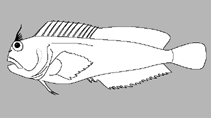
Dorsale stekels (totaal) : 11 - 12; Dorsale zachte stralen (totaal) : 18 - 19; Anale stekels: 2; Anale zachte stralen: 19 - 22. This species is distinguished by the following characters: 18-19 segmented dorsal fin rays;
(19-)20-21(-22) segmented anal fin rays; 3 segmented pelvic fin rays; simple, fusiform supraorbital tentacle, shorter than eye diameter; head with dark pigmentation, with a deep dark area between the central cheeks, the upper orbital rim and the corner of the mouth; dark snout and central three-fifths of the upper lip, other parts light; lower sides of head with dark pigmentation, darkest in the central part of the anterior half; central part of posterior half of lower sides of head with a transversely oval, black blotch, its size about half eye diameter; pelvic fin base black directly behind the opercular membrane; a row of 7 dark, longitudinal, oval blotches with an even darker centre at the sides of body (Ref. 76835).
Body shape (shape guide): fusiform / normal.
Facultative air-breathing (Ref. 126274); Adults inhabit reef flats in the intertidal zone and also found in rocky shorelines exposed to strong tide surges (Ref. 90102). Oviparous. Eggs are demersal and adhesive (Ref. 205), and are attached to the substrate via a filamentous, adhesive pad or pedestal (Ref. 94114). Larvae are planktonic, often found in shallow, coastal waters (Ref. 94114).
Levenscyclus en paargedrag
Maturiteit | Voortplanting | Paaien | Eieren | Fecunditeit | Larven
Oviparous, distinct pairing (Ref. 205).
Bath, H., 2004. Revision of the genus Rhabdoblennius Whitley (Pisces: Blenniidae: Salariinae), with descriptions of two new species. Stuttg. Beitr. Naturkd. (A Biol.) 669:1-28. (Ref. 76835)
Status op de Rode Lijst van het IUCN (Ref. 130435: Version 2025-2 (Global))
Gevaar voor de mens
Harmless
Gebruik door de mens
Visserij: visserij voor eigen gebruik
Tools
Speciale rapporten
Download XML
Internetbronnen
Schattingen op basis van modellen
Fylogenetische diversiteitsindex (Ref.
82804): PD
50 = 0.5312 [Uniqueness, from 0.5 = low to 2.0 = high].
Bayesian length-weight: a=0.01047 (0.00463 - 0.02370), b=2.98 (2.79 - 3.17), in cm total length, based on LWR estimates for this (Sub)family-body shape (Ref.
93245).
Weerstandsvermogen (Ref.
120179): Hoog, minimale populatieverdubbelingstijd minder dan 15 maanden (Preliminary K or Fecundity.).
Kwetsbaarheid van de visserij (Ref.
59153): Low vulnerability (10 of 100).
🛈