>
Cypriniformes (Carps) >
Xenocyprididae (East Asian minnows)
Etymology: Candidia: Latin, candidus, candere = to be white, glisten (Ref. 45335); pingtungensis: Named after the County Pingtung in southern Taiwan.
Entorno: milieu / zona climática / rango de profundidad / gama de distribución
Ecología
; agua dulce bentopelágico; pH range: 7.5 - 8.8. Subtropical
Asia: Tongkang River southwards to all western drainages of Hengchuen Peninsula and also to the eastern drainage of the Kongkou River and most of Pingtung Country, Taiwan.
Tamaño / Peso / Edad
Madurez: Lm ? range ? - ? cm
Max length : 11.4 cm SL macho / no sexado; (Ref. 79878)
Descripción breve
Claves de identificación | Morfología | Morfometría
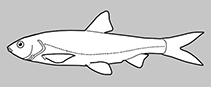
Radios blandos dorsales (total) : 10; Radios blandos anales: 12 - 13; Vértebra: 44 - 46. Diagnosed from all other species of the genus Candidia by the following unique combination of characters: dorsal fin with iii,7 rays; anal fin with iii,9-10 rays; pectoral fin with I, 14 rays ; scales on lateral line 46-50; scales above lateral line 9-10; scales below lateral line 3-4; predorsal scales 19-21; gill rakers 2+6 (total 8); pharyngeal teeth always 1,3,5 -4,4,1; shallow ventral keel on the posterior half of region between pelvic fin and anus; cheek with a series of 3-5 nuptial tubercles on cheek and lower jaw in adult males with 5-7 nuptial tubercles; eye large, eye diameter about equal to cheek depth in adult male; body with a uniform broad, longitudinal black stripe from upper opercle, through mid-lateral to caudal fin base; dorsal side dark grayish, a broad silvery white stripe just above the longitudinal black stripe; ventral side silvery-white; dorsal fin pinkish-red with distal transverse black bars in male; and eye with red-black region on dorsal two-third of eye iris (Ref. 79878).
Body shape (shape guide): elongated.
Occurs in the anterior portion of pools and edge-water habitats up to 2 m depth with benthic substratum composed of small pebbles to large boulders under slow to moderate water flow, in small and very clear tributaries and headwaters with better shaded vegetation along the stream bank (Ref. 79878).
Ciclo vital y comportamiento de apareamiento
Madurez | Reproducción | Puesta | Huevos | Fecundidad | Larva
Chen, I.-S., J.-H. Wu and C.-H. Hsu, 2008. The taxonomy and phylogeny of Candidia (Teleostei: Cyprinidae) from Taiwan, with description of a new species and comments on a new genus. The Raffles Bull. Zool. 19:203-214. (Ref. 79878)
Situación en la Lista Roja de la UICN (Ref. 130435: Version 2025-2 (Global))
Amenaza para el ser humano
Harmless
Usos humanos
Herramientas
Informes especiales
Descargar XML
Fuentes de Internet
Estimaciones basadas en modelos
Índice de diversidad filogenética (Referencia
82804): PD
50 = 0.7500 [Uniqueness, from 0.5 = low to 2.0 = high].
Bayesian length-weight: a=0.00631 (0.00298 - 0.01335), b=3.07 (2.90 - 3.24), in cm total length, based on LWR estimates for this (Sub)family-body shape (Ref.
93245).
Nivel trófico (Referencia
69278): 3.1 ±0.4 se; based on size and trophs of closest relatives
Resiliencia (Referencia
120179): Alto, población duplicada en un tiempo mínimo inferior a 15 meses (Preliminary K or Fecundity.).
Vulnerabilidad pesquera (Ref.
59153): Low vulnerability (10 of 100).
🛈