>
Perciformes/Percoidei (Perchs) >
Percidae (Perches) > Etheostomatinae
Etymology: Etheostoma: Greek, etheo = to strain + Greek, stoma = mouth; Rafinesque said "various mouths", but Jordan and Evermann suggest the name might have been intended as "Heterostoma (Ref. 45335); lemniscatum: The name marmorpinnum comes from marmor which means marbled and pinna for fin and refers to the distinct marbled pattern of the second dorsal fin of nuptial males, as does the common name Marbled Darter.
Entorno: milieu / zona climática / rango de profundidad / gama de distribución
Ecología
; agua dulce bentopelágico. Temperate
North America: USA. The Tuxedo Darter occurs in an approximately 19 km mainstem stretch of the Big South Fork Cumberland River, with most individuals observed from the mouth of Station Camp Creek, Scott County, Tennessee, to Bear Creek, McCreary County, Kentucky (Eisenhour & Burr 2000) (Ref. 79849).
Tamaño / Peso / Edad
Madurez: Lm ? range ? - ? cm
Max length : 5.4 cm SL macho / no sexado; (Ref. 79849)
Descripción breve
Claves de identificación | Morfología | Morfometría
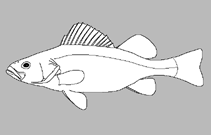
Etheostoma lemniscatum is distinguished from all members of the complex by more posterior positioned anal fin (B6–B8, =332 vs. 317 or less); pectoral fin of nuptial males with dark, distal band confined to rays of the dorsal half or less of fin (vs. across all rays or all but 1–4 ventral rays); and nuptial males with dark and distinctly defined black bands on the distal margin of the caudal, anal, and second dorsal fins
(bands more diffuse in other species). Etheostoma lemniscatum is further distinguished from all members of the complex except E. marmorpinnum by higher modal (44 vs. 43 or less) number of lateral scale rows; and intermediate number of pored lateral line scales (26 or 28 vs. 22 in E. percnurum, and 34 in E. sitikuense). From E. marmorpinnum and E. percnurum by intermediate percentage of the first dorsal base area covered by scales (60% vs. 100% in E. marmorpinnum and 20% in E. percnurum); and an intermediate number of scales around caudal peduncle (24 vs. 25 and 23, respectively). From E. marmorpinnum and E. sitikuense by wider
distal band on anal fin (50% of fin height vs. 29–39%) and second dorsal fin (25% of fin height vs. 14–16%); and lack of marbling or tessellations in the medial portion of the second dorsal fin of nuptial males. From E.
marmorpinnum by lower percentage of belly covered by scales (10% vs. 60–80%); and wider, distal caudal–fin band (18% of fin length vs. 12–15%). From E. percnurum by lower number of caudal-fin rays (16 vs. 18); presence of strong tessellations on medial portion of caudal fin of nuptial males (vs. no tessellations); and
narrower distal band on the pectoral fin (range = 14–18% vs. 27–32%). Means of other measurements were also informative for distinguishing E. lemniscatum from members of the complex (Ref. 79849).
Body shape (shape guide): elongated.
Ciclo vital y comportamiento de apareamiento
Madurez | Reproducción | Puesta | Huevos | Fecundidad | Larva
Blanton, R.E. and R.E. Jenkins, 2008. Three new darter species of the Etheostoma percnurum species complex (Percidae, subgenus Catonotus) from the Tennessee and Cumberland river drainages. Zootaxa 1963:1-24. (Ref. 79849)
Situación en la Lista Roja de la UICN (Ref. 130435: Version 2025-2 (Global))
Amenaza para el ser humano
Harmless
Usos humanos
Herramientas
Informes especiales
Descargar XML
Fuentes de Internet
Estimaciones basadas en modelos
Índice de diversidad filogenética (Referencia
82804): PD
50 = 0.5000 [Uniqueness, from 0.5 = low to 2.0 = high].
Bayesian length-weight: a=0.00676 (0.00303 - 0.01510), b=3.12 (2.94 - 3.30), in cm total length, based on LWR estimates for this Genus-body shape (Ref.
93245).
Nivel trófico (Referencia
69278): 3.3 ±0.5 se; based on size and trophs of closest relatives
Resiliencia (Referencia
120179): Alto, población duplicada en un tiempo mínimo inferior a 15 meses (Preliminary K or Fecundity.).
Vulnerabilidad pesquera (Ref.
59153): Low vulnerability (10 of 100).
🛈