Meio ambiente: milieu / Zona climática / intervalo de profundidade / faixa de distribuição
Ecologia
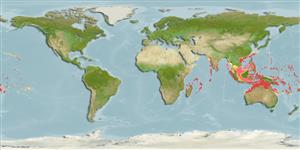
marinhas associadas(os) a recifes; intervalo de profundidade 0 - 120 m (Ref. 9710), usually 15 - 120 m (Ref. 9710). Tropical; 29°N - 24°S, 38°E - 144°W (Ref. 5222)
Indo-Pacific: northern Mozambique to French Polynesia, north to Okinawa, south to the northern Great Barrier Reef. Unknown from the Red Sea and Persian Gulf. Recorded from Europa Island (MNHN 1992-0983, Ref. 33390).
Tamanho / Peso / Idade
Maturidade: Lm ? range ? - ? cm
Max length : 40.0 cm TL macho/indeterminado; (Ref. 9710)
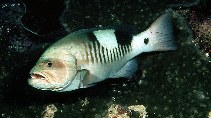
Espinhos dorsais (total) : 9; Raios dorsais (total) : 14 - 16; Espinhos anais: 3; Raios anais : 9 - 10. Readily identified by the white square on their sides, blue in natural light (Ref. 48635). Differs from all shallow water Micronesian Cephalopholis except C. polleni by having truncate tail (Ref. 37816). Characterized further by: greenish or reddish brown to brownish grey body color , with several narrow curved dark bars on the midlateral part of the body; dark brown spot midlaterally on the caudal peduncle; 3-5 blue lines across head; oblong body, slightly compressed, depth contained 2.6-3.3 times in SL; width of body 1.8-2.3 times in depth; head smaller compared to other groupers, head length 2.9-3.2 times in SL; evenly convex dorsal head profile; slightly convex interorbital area, width greater than eye diameter; narrow preorbital, depth distinctly less than eye diameter, preorbital depth 10-15 times in HL; rounded preopercle, finely serrate, smooth and fleshy lower edge; ventral edge of subopercle and interopercle smooth; posterior and anterior nostril subequal in size; posterior part of maxilla with hook-shaped or step-like expansion on ventral edge in adults; well developed supramaxilla; pair of small canines at front of jaws; presence of palatine teeth; 2 rows of teeth on midside of lower jaw, inner teeth depressible and twice as long as outer teeth (Ref. 89707).
Body shape (shape guide): fusiform / normal; Cross section: oval.
An active swimmer usually found on outer reef slopes and channels adjacent to deep water. Hovers above the bottom and probably feeds primarily on fishes (Ref. 9710). It is uncommon and usually solitary, however Myers (1989, Ref. 4538) reported of occasional sightings of groups of 3 or 4 fish. Solitary, hovering in midwater (Ref 90102). Minimum depth reported taken from Ref. 128797.
Ciclo de vida ou comportamento de acasalamento
Maturidade | Reprodução | Desova | Ovos | Fecundidade | Larvas
Heemstra, P.C. and J.E. Randall, 1993. FAO Species Catalogue. Vol. 16. Groupers of the world (family Serranidae, subfamily Epinephelinae). An annotated and illustrated catalogue of the grouper, rockcod, hind, coral grouper and lyretail species known to date. Rome: FAO. FAO Fish. Synop. 125(16):382 p. (Ref. 5222)
Status na Lista Vermelha da UICN (Ref. 130435: Version 2025-2 (Global))
Ameaça para os humanos
Harmless
Uso pelos humanos
Pescarias: pouco comercial; peixe esportivo: sim
Ferramentas
Relatórios especiais
Baixar XML
Fontes da internet
Estimativas baseadas em modelos
Temperatura preferida (Ref.
123201): 22.1 - 28.9, mean 27.2 °C (based on 604 cells).
Índice de diversidade filogenética (Ref.
82804): PD
50 = 1.0000 [Uniqueness, from 0.5 = low to 2.0 = high].
Bayesian length-weight: a=0.01122 (0.00550 - 0.02289), b=3.04 (2.88 - 3.20), in cm total length, based on LWR estimates for this (Sub)family-body shape (Ref.
93245).
Nível Trófico (Ref.
69278): 4.2 ±0.73 se; based on food items.
Resiliência (Ref.
120179): médio(a), tempo mínimo de duplicação da população 1,4 - 4,4 anos (Preliminary K or Fecundity.).
Vulnerabilidade da pesca (Ref.
59153): Low to moderate vulnerability (30 of 100).
🛈
Nutrientes (Ref.
124155): Calcium = 38.4 [23.0, 66.3] mg/100g; Iron = 0.569 [0.315, 0.923] mg/100g; Protein = 18.5 [16.7, 20.1] %; Omega3 = 0.165 [0.111, 0.251] g/100g; Selenium = 35 [21, 63] μg/100g; VitaminA = 161 [59, 504] μg/100g; Zinc = 0.929 [0.646, 1.312] mg/100g (wet weight);