>
Cypriniformes (Carps) >
Nemacheilidae (Brook loaches)
Etymology: Triplophysa: Greek, triplos = thrice + Greek, physa = tube (Ref. 45335); waisihani: The specific epithet is a reference to Wai Si Han, the Chinese spelling of the Wais Khan, (a tenth-generation male offspring of the Mongolian emperor Genghis Khan), whose mausoleum is located in the Dunmaza Town (in Yining County of the Xinjiang-Uighur a.
Eponymy: Wai Si Han (Chinese spelling of Wais Khan) was the 10th-generation male offspring of the Mongolian emperor Genghis Khan, whose mausoleum is located in Dunmaza Town (Yining County, Xinjiang-Uighur, China); the type locality. (Ref. 128868), visit book page.
Ambiente: milieu / zona climática / intervalo de profundidade / gama de distribuição
Ecologia
; Água doce bentopelágico. Temperate; 44°N - 43°N, 81°E - 82°E
Asia: China. Known from the Kax River, a tributary to the Ili River drainage, at Dunmaza Town in Yining County (81°53'E, 43°82'N; 1143m above sea level) of Xinjiang-Uighur Autonomous Region, Northwestern China. It was also documented by Zhu (1989, 1995) from the Ili River and Emin River drainages of Xinjiang, without precise locality and by Wu & Wu (1992) from the Manas River drainage (Ref. 79615).
Tamanho / Peso / Idade
Maturidade: Lm ? range ? - ? cm
Max length : 14.0 cm macho/indeterminado; (Ref. 79615)
Descrição breve
Chaves de identificação | Morfologia | Morfometria
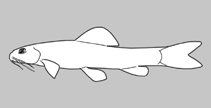
Espinhos dorsais (total) : 3; Raios dorsais moles (total) : 7; Espinhos anais: 3; Raios anais moles: 5. Triplophysa waisihani belongs to the T. labiata species-group that is characterized by having widely separated anterior and posterior nostrils and no breeding tubercles on the sides of the head. It resembles T. labiata and T. herzensteini, with which it shares the presence of a columnar caudal peduncle with an
approximately circular cross-section at its beginning, but differs from both in possessing supraorbital and infraorbital canals that are not confluent (vs. confluent); and the posterior chamber of the gas bladder connected to the anterior chamber by a long duct, twice as long as the posterior chamber (vs. connected to the
anterior chamber by a shorter duct than the posterior chamber in T. labiata, or strongly reduced in T. herzensteini). It further differs from T. labiata in the possession of an anteriorly bifurcated (vs. non-bifurcated) pelvic girdle and in the absence (vs. presence) of the fourth basibranchial, and from T. herzensteini in having a truncate or slightly convex (vs. concave) distal margin of the anal fin (Ref. 79615).
Coloration of live specimens: ground colour of back, and lateral body gray, somewhat lighter ventrally; ventral region of body yellowish white. Six or seven brown transverse bars on predorsal region, five or six bars on postdorsal region of body. Many spots on flank above lateral line and area directly below. A longitudinal
light-yellow stripe running along lateral line, becoming increasingly narrower and ending at vertical through vent. Dorsal and caudal fins dusky. Dorsal surfaces of pectoral and pelvic fins gray. Anal fin hyaline (Ref. 79615).
Body shape (shape guide): elongated.
Ciclo de vida e comportamento de acasalamento
Maturidade | Reprodução | Desova | Ovos | Fecundidade | Larvas
Cao, L. and E. Zhang, 2008. Triplophysa waisihani, a new species of nemacheiline loach from Northwest China (Pisces: Balitoridae). Zootaxa 1932:33-46. (Ref. 79615)
Categoria na Lista Vermelha da IUCN (Ref. 130435: Version 2025-2 (Global))
Ameaça para o homem
Harmless
Utilização humana
Ferramentas
Relatórios especiais
Descarregue XML
Fontes da internet
Estimativas baseadas em modelos
Índice de diversidade filogenética (Ref.
82804): PD
50 = 0.5000 [Uniqueness, from 0.5 = low to 2.0 = high].
Bayesian length-weight: a=0.00708 (0.00336 - 0.01491), b=3.00 (2.83 - 3.17), in cm total length, based on LWR estimates for this Genus-body shape (Ref.
93245).
Nível Trófico (Ref.
69278): 3.1 ±0.4 se; based on size and trophs of closest relatives
Resiliência (Ref.
120179): Médio, tempo mínimo de duplicação da população 1,4 - 4,4 anos (Preliminary K or Fecundity.).
Vulnerabilidade da pesca (Ref.
59153): Low vulnerability (10 of 100).
🛈