>
Perciformes/Serranoidei (Groupers) >
Epinephelidae (Groupers)
Etymology: Epinephelus: Greek, epinephelos = cloudy (Ref. 45335).
Eponymy: Jean René Constant Quoy (1790–1869) was a French naval surgeon and zoologist who named many species, often with Joseph Paul Gaimard (q. [...] (Ref. 128868), visit book page.
More on author: Valenciennes.
Meio ambiente: milieu / Zona climática / intervalo de profundidade / faixa de distribuição
Ecologia
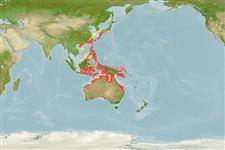
marinhas associadas(os) a recifes; intervalo de profundidade ? - 50 m (Ref. 5222). Tropical; 35°N - 32°S, 110°E - 156°E (Ref. 5222)
Western Pacific: Japan to Australia. Unknown from the Indian Ocean except for the Andaman Islands record (as Serranus merra). Unreported from islands of Micronesia, Melanesia and central Pacific. Often misidentified as Epinephelus macrospilos or Epinephelus hexagonatus.
Comprimento de primeira maturação / Tamanho / Peso / Idade
Maturidade: Lm ?, range 18 - ? cm
Max length : 40.0 cm TL macho/indeterminado; (Ref. 48635)
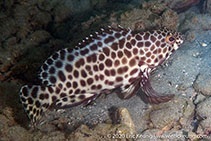
Espinhos dorsais (total) : 11; Raios dorsais (total) : 16 - 18; Espinhos anais: 3; Raios anais : 8. Distinguished by the following characteristics: whitish color; head, body and fins with numerous large close-set hexagonal to roundish dark brown to blackish spots; ctenoid body scales except cycloid dorsoanteriorly above lateral line, on thorax and abdomen; body with auxiliary scales; greatest depth of body 2.7-3.2 in SL; rounded caudal fin; pelvic fins, 1.7-2.1 in head length (Ref. 90102); head length 2.3-2.6 times in SL; evenly curved dorsal head profile; snout subequal to eye diameter, snout length 4.6-5.3 times in HL; rounded preopercle or subangular; upper edge of operculum almost straight; posterior nostril diameter about twice that of anterior nostrils; maxilla reaches to or past vertical at rear edge of eye; 2-3 rows of teeth on midlateral part of lower jaw; lower jaw barely projecting in front of upper jaw (Ref. 89707).
Body shape (shape guide): fusiform / normal; Cross section: compressed.
Inhabits inshore silty reefs; there are no records from depths greater than 50 m. Feeds on shrimps, small fishes, worms and crabs (Ref. 89707). The enlarged fleshy pectoral fins appear to have resulted from its habit of sitting on the substrate. Solitary (Ref 90102).
Ciclo de vida ou comportamento de acasalamento
Maturidade | Reprodução | Desova | Ovos | Fecundidade | Larvas
Heemstra, P.C. and J.E. Randall, 1993. FAO Species Catalogue. Vol. 16. Groupers of the world (family Serranidae, subfamily Epinephelinae). An annotated and illustrated catalogue of the grouper, rockcod, hind, coral grouper and lyretail species known to date. Rome: FAO. FAO Fish. Synop. 125(16):382 p. (Ref. 5222)
Status na Lista Vermelha da UICN (Ref. 130435: Version 2025-2 (Global))
Ameaça para os humanos
Reports of ciguatera poisoning (Ref. 30298)
Uso pelos humanos
Pescarias: espécies comerciais
Ferramentas
Relatórios especiais
Baixar XML
Fontes da internet
Estimativas baseadas em modelos
Temperatura preferida (Ref.
123201): 24.5 - 28.9, mean 27.7 °C (based on 504 cells).
Índice de diversidade filogenética (Ref.
82804): PD
50 = 0.5000 [Uniqueness, from 0.5 = low to 2.0 = high].
Bayesian length-weight: a=0.01349 (0.00847 - 0.02147), b=3.05 (2.92 - 3.18), in cm total length, based on LWR estimates for this species & Genus-body shape (Ref.
93245).
Nível Trófico (Ref.
69278): 4.0 ±0.5 se; based on diet studies.
Resiliência (Ref.
120179): médio(a), tempo mínimo de duplicação da população 1,4 - 4,4 anos (Preliminary K or Fecundity.).
Vulnerabilidade da pesca (Ref.
59153): Low to moderate vulnerability (30 of 100).
🛈
Nutrientes (Ref.
124155): Calcium = 34 [16, 71] mg/100g; Iron = 0.584 [0.306, 1.188] mg/100g; Protein = 18.4 [16.8, 19.8] %; Omega3 = 0.125 [0.078, 0.197] g/100g; Selenium = 30.1 [16.9, 58.5] μg/100g; VitaminA = 329 [88, 1,239] μg/100g; Zinc = 1.27 [0.85, 1.83] mg/100g (wet weight);