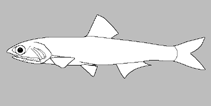
Klassifizierung / Names
Namen | Synonyme | Catalog of Fishes(Gattung, Arten) | ITIS | CoL | WoRMS | Cloffa
>
Clupeiformes (Herrings) >
Engraulidae (Anchovies) > Engraulinae
Etymology: Engraulis: Greek, eggraulis, -eos = anchovy (Ref. 45335); maeoticus: Named for the antique Meotian people that used to inhabit the banks of the Azov Sea.
Taxonomic Remarks
ECoF (as of v. 04 Oct. 2022) keeps Engraulis albidus Borsa, Collet & Durand, 2004 as a separated valid species because the status of types is not explicitly stated in Ref. 126017.
Umwelt: Milieu / Klimazone / Tiefenbereich / Verbreitungsgebiet
Ökologie
seewasser; brackwasser pelagic-neritic. Subtropical
Meditteranean: apparently along the shoreline of Camargue in NW Mediterranean Sea; Mauguio, Prevost, and Thau lagoons in southern France; northern Adriatic Sea.
Größe / Gewicht / Alter
Geschlechtsreife: Lm ? range ? - ? cm
Max length : 9.5 cm SL Männchen/unbestimmt; (Ref. 76782)
This species is observed in brackish lagoons from the start of spring to the end of summer; leaves the lagoons in autumn to the nearby coastal marine waters (see Ref. 126017:598). It is presumed to spawn in lagoons in the summer (based on the observation of concentrations of small-sized anchovies together with large densities of eggs in the Thau lagoon, southern France, in July and on the presence of sexually mature individuals, 8-9 cm SL, in the Mauguio and Prevost lagoons, southern France, observed as early as May. In the northern Adriatic Sea, it lives at salinities less than 38 psu and depths less than 50 m (Ref. 76782).
Lebenszyklus und Paarungsverhalten
Geschlechtsreife | Fortpflanzung | Ablaichen | Eier | Fruchtbarkeit | Larven
Bonhomme, F., L. Meyer, C. Arbiol, D. Bănaru, L. Bahri‐Sfar, K. Fadhlaoui‐Zid, P. Strelkov, M. Arculeo, L. Soulier, J. Quignard and P. Gagnaire, 2022. Systematics of European coastal anchovies (genus Engraulis Cuvier). J. Fish Biol. 100(2):594-600. (Ref. 126017)
IUCN Rote Liste Status (Ref. 130435: Version 2025-2 (Global))
Bedrohung für Menschen
Harmless
Nutzung durch Menschen
Tools
Zusatzinformationen
Download XML
Internet Quellen
Schätzungen auf der Grundlage von Modellen
Phylogenetischer Diversitätsindex (Ref.
82804): PD
50 = 0.5020 [Uniqueness, from 0.5 = low to 2.0 = high].
Bayesian length-weight: a=0.00457 (0.00211 - 0.00989), b=3.13 (2.96 - 3.30), in cm total length, based on LWR estimates for this Genus-body shape (Ref.
93245).
Trophische Ebene (Ref.
69278): 3.0 ±0.1 se; based on size and trophs of closest relatives
Widerstandsfähigkeit (Ref.
120179): hoch, Verdopplung der Population dauert weniger als 15 Monate. (Preliminary K or Fecundity.).
Anfälligkeit der Fischerei (Ref.
59153): Low vulnerability (10 of 100).
🛈