Ambiente: milieu / zona climática / intervalo de profundidade / gama de distribuição
Ecologia
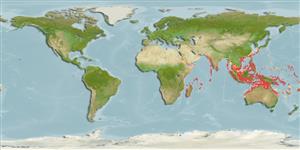
marinhas; estuarina associadas(os) a recifes; não migratória (Ref. 130262); intervalo de profundidade 20 - 60 m (Ref. 89707). Tropical; 36°N - 27°S, 31°E - 179°W (Ref. 5222)
Indo-West Pacific: East Africa to the Ryukyu Islands, Marshall Islands, Fiji, New Caledonia, and northern Australia. Recently recorded from Tonga (Ref. 53797). Reported from Somalia and India by Heemstra & Randall in 1984 but valid records and specimens have not been found (Ref. 4787). Closely related to Epinephelus summana known only from the Red Sea.
Comprimento na primeira maturidade / Tamanho / Peso / Idade
Maturidade: Lm ?, range 16 - ? cm
Max length : 40.0 cm TL macho/indeterminado; (Ref. 27362)
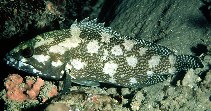
Espinhos dorsais (total) : 11; Raios dorsais moles (total) : 14 - 16; Espinhos anais: 3; Raios anais moles: 8. This species is distinguished by the following characters: body depth 2.7-3.2 in SL; head length 2.3-2.5 in SL; head pointed, flat interorbital area, dorsal head profile slightly convex; preopercle rounded, serrae small and mostly covered by skin; upper edge of operculum strongly convex, the rear edge almost vertical, the upper spine extending posterior to lower spine; rear nostril diameter about twice that of anterior nostril; small, embedded scales on maxilla; 2-4 rows of small teeth at midlateral part of lower jaw; canines at front of jaws small or absent; gill rakers of first gill arch 8-10 + 15-18 (including 6 to 8 rudiments on each limb); caudal fin rounded; pectoral fins large and fleshy, with 15-17 rays, the fin length 1.4-1.7 in HL; short pelvic fins, 1.9-2.4 in HL; lateral-line scales 48-53; lateral scale series 95-110. Colour of body brown, with numerous small white spots (in specimens >10 cm SL), horizontally elongate and tend to form wavy white lines in adults, several round or irregular pale blotches (eye-sized or larger) usually superimposed over small white spots, head brown, with numerous small white spots dorsally behind eyes; black maxillary streak usually hidden by maxilla, median fins with small white spots and streaks, the posterior margin blackish with a white edge, paired fins are greyish brown; juveniles of about 6 cm SL are brown, covered with small, dark-edged white spots which are round, except on front part of dorsal fin where they are elongated; white spots on paired fins become fewer and fainter with growth, and are absent in adults (Ref. 39231, 89707, 90102).
Body shape (shape guide): fusiform / normal; Cross section: compressed.
Adults inhabit inner coastal and lagoon reefs, also found in brackish waters in ledges and caves (Ref. 5213). Adults usually found deeper than 20 m (Ref. 48635). Solitary (Ref 90102). They feed on crustaceans and small fishes (Ref. 89707). Are cryptic species which are not very common, but of some interest to fisheries in Japan (and probably elsewhere). Caught with hook-and-line, spear, and traps (Ref. 39231).
Ciclo de vida e comportamento de acasalamento
Maturidade | Reprodução | Desova | Ovos | Fecundidade | Larvas
Heemstra, P.C. and J.E. Randall, 1993. FAO Species Catalogue. Vol. 16. Groupers of the world (family Serranidae, subfamily Epinephelinae). An annotated and illustrated catalogue of the grouper, rockcod, hind, coral grouper and lyretail species known to date. Rome: FAO. FAO Fish. Synop. 125(16):382 p. (Ref. 5222)
Categoria na Lista Vermelha da IUCN (Ref. 130435: Version 2025-2 (Global))
Ameaça para o homem
Harmless
Utilização humana
Pescarias: pouco comercial
Ferramentas
Relatórios especiais
Descarregue XML
Fontes da internet
Estimativas baseadas em modelos
Temperatura preferida (Ref.
123201): 24.5 - 28.6, mean 27.8 °C (based on 320 cells).
Índice de diversidade filogenética (Ref.
82804): PD
50 = 0.5000 [Uniqueness, from 0.5 = low to 2.0 = high].
Bayesian length-weight: a=0.01148 (0.01003 - 0.01314), b=3.04 (3.02 - 3.06), in cm total length, based on LWR estimates for this species (Ref.
93245).
Nível Trófico (Ref.
69278): 4.0 ±0.66 se; based on food items.
Generation time: 3.3 ( na - na) years. Estimated as median ln(3)/K based on 1
growth studies.
Resiliência (Ref.
120179): Baixo, tempo mínimo de duplicação da população 4,5 - 14 anos (K=0.3; tmax=20; tm=3;).
Vulnerabilidade da pesca (Ref.
59153): Low to moderate vulnerability (33 of 100).
🛈
Nutrientes (Ref.
124155): Calcium = 34.8 [15.3, 69.1] mg/100g; Iron = 0.518 [0.272, 1.055] mg/100g; Protein = 18.8 [17.3, 20.3] %; Omega3 = 0.145 [0.089, 0.233] g/100g; Selenium = 30.7 [17.2, 57.6] μg/100g; VitaminA = 189 [46, 791] μg/100g; Zinc = 1.53 [1.03, 2.15] mg/100g (wet weight);