Classificazione / Nomi
Nomi Comuni | Sinonimi | Catalog of Fishes(Genere, Specie) | ITIS | CoL | WoRMS | Cloffa
>
Gobiiformes (Gobies) >
Gobiidae (Gobies) > Gobiinae
Etymology: Peter: The generic name Peter refers to the first name of two outstanding goby enthusiasts: Peter J. Miller, the British goby systematicist and Peter Wirtz, the German naturalist and biologist; amicuscaridis: Name from Latin noun 'amicus' for friend and 'caris, caridis' for shrimp, refer to the obligatory association of the new species with shrimp burrows.
Ambiente: milieu / zona climatica / distribuzione batimetrica / gamma di distribuzione
Ecologia
marino benthopelagico; distribuzione batimetrica 7 - 25 m (Ref. 79573). Tropical; 1°N - 0°N
North Atlantic Ocean: São Tomé Island.
Dimensione / Peso / Età
Maturità: Lm ? range ? - ? cm
Max length : 3.2 cm SL maschio/sesso non determinato; (Ref. 79573)
Breve descrizione
Chiavi di identificazione | Morfologia | Morfometria
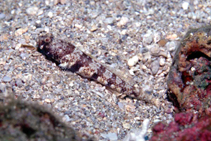
Body moderately elongate and laterally compressed, head moderately depressed; interorbital space very narrow, dorsolaterally positioned eyes. Mouth strongly oblique, lower jaw slightly projecting, posterior angle of jaws below mideye. Snout shorter than eye and rounded in dorsal view. Anterior nostril tubular (longer than diameter), without process from rim, barely reaching but not overlapping the upper lip; posterior nostril slightly erected, but not tubular. Chin lacking barbels. Upper lips anteriorly slightly thinner than laterally. Branchiostegal membrane attached along entire lateral margin; gill opening approximately at the level of lower edge of pectoral fin base. Cranial roof covered by dorsal axial musculature. Pectoral girdle without dermal flaps on anterior edge. Tongue truncate (Ref. 79573).
Body shape (shape guide): fusiform / normal.
It was observed that only single specimens were found at the entrance of burrows of the axiid shrimp Axiopsis serratifrons; in depths from 7 m to 25 m (P. Wirtz, pers.comm. in Ref. 79573). Stomach contents visible on the radiograph of the holotype show at least 6 snails
of different families: one of Sinozona sp. (Scissurellidae), and several which most likely
belong to Rissoidae and Limacinidae (Schwabe, pers.comm. In Ref. 79573).
Ciclo vitale e comportamento di accoppiamento
Maturità | Riproduzione | Deposizione | Uova | Fecondità | Larve
Schliewen, U.K. and M. Kovačić, 2008. Didogobius amicuscaridis spec. nov. and D. wirtzi spec. nov., two new species of symbiotic gobiid fish from São Tomé and Cape Verde islands. Spixiana 31(2):247-261. (Ref. 79573)
Stato della Lista Rossa IUCN (Ref. 130435: Version 2025-2 (Global))
Minaccia per l'uomo
Harmless
Usi umani
Strumenti
Rapporti speciali
Scarica XML
Fonti Internet
Stime basate su modelli
Indice di diversità filogenetica (Fonte Biblio.
82804): PD
50 = 0.7500 [Uniqueness, from 0.5 = low to 2.0 = high].
Bayesian length-weight: a=0.01023 (0.00477 - 0.02194), b=3.01 (2.83 - 3.19), in cm total length, based on LWR estimates for this (Sub)family-body shape (Ref.
93245).
Livello trofico (Fonte Biblio.
69278): 3.1 ±0.3 se; based on size and trophs of closest relatives
Resilienza (Fonte Biblio.
120179): Alto, tempo minimo di raddoppiamento della popolazione meno di 15 mesi (Preliminary K or Fecundity.).
Vulnerabilità della pesca (Ref.
59153): Low vulnerability (10 of 100).
🛈