Clasificación / Nombres
Nombres comunes | Sinónimos | Catalog of Fishes(Género, Especie) | ITIS | CoL | WoRMS | Cloffa
>
Siluriformes (Catfishes) >
Pimelodidae (Long-whiskered catfishes)
Etymology: Pimelodus: Greek, pimele = fat + Greek, odous = teeth (Ref. 45335); stewarti: Named for Donald Stewart, in recognition of his many contributions to catfish systematics.
Eponymy: Dr Donald James Stewart (d: 1946) is Professor of Environment & Forest Biology at the College of Environmental Science and Forestry, State University of New York, Syracuse, where he presently teaches Ichthyology & Tropical Ecology. [...] (Ref. 128868), visit book page.
Entorno: milieu / zona climática / rango de profundidad / gama de distribución
Ecología
; agua dulce demersal. Tropical
South America: Rio Tocantins drainage in Brazil.
Tamaño / Peso / Edad
Madurez: Lm ? range ? - ? cm
Max length : 6.6 cm SL macho / no sexado; (Ref. 79502)
Descripción breve
Claves de identificación | Morfología | Morfometría
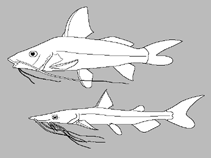
Espinas dorsales (total) : 2; Radios blandos dorsales (total) : 6 - 7; Vértebra: 40. Differs from its congeners, except Pimelodus halisodous, Pimelodus joannis, Pimelodus ornatus and Pimelodus pictus, by having the following characters: distal portion of dorsal-fin rays 2-4 with a dark spot; just anterior to dorsal fin with dark transverse band; shorter distance between the posterior nostril and the anterior orbital border (posterior nostril closer to anterior orbital border. Can be separated from Pimelodus ornatus and Pimelodus pictus by its flank with uniform gray coloration lateral line with a light narrow band; from Pimelodus joannis by having a greater posterior cleithral-process length (12.7-15.6 vs. 10.2-12.4% of SL) and by lacking dark blotches on the caudal-fin base and from Pimelodus halisodous by a smaller pectoral- spine length (15.4-19.6 vs. 20.0-23.5% of SL); a shorter snout (36.1-40.9 vs. 43.1-47.9% of HL); and by having fewer rows of premaxillary teeth (5-8 vs. 13-16) (Ref. 79502).
Body shape (shape guide): elongated.
Ciclo vital y comportamiento de apareamiento
Madurez | Reproducción | Puesta | Huevos | Fecundidad | Larva
Ribeiro, F.R.V., C.A.S. Lucena and P.H.F. Lucinda, 2008. Three new Pimelodus species (Siluriformes: Pimelodidae) from the rio Tocantins drainage, Brazil. Neotrop. Ichthyol. 6(3):455-464. (Ref. 79502)
Situación en la Lista Roja de la UICN (Ref. 130435: Version 2025-2 (Global))
Amenaza para el ser humano
Harmless
Usos humanos
Herramientas
Informes especiales
Descargar XML
Fuentes de Internet
Estimaciones basadas en modelos
Índice de diversidad filogenética (Referencia
82804): PD
50 = 0.5000 [Uniqueness, from 0.5 = low to 2.0 = high].
Bayesian length-weight: a=0.00692 (0.00304 - 0.01573), b=3.10 (2.92 - 3.28), in cm total length, based on LWR estimates for this Genus-body shape (Ref.
93245).
Nivel trófico (Referencia
69278): 3.2 ±0.5 se; based on size and trophs of closest relatives
Resiliencia (Referencia
120179): Alto, población duplicada en un tiempo mínimo inferior a 15 meses (Preliminary K or Fecundity.).
Vulnerabilidad pesquera (Ref.
59153): Low vulnerability (10 of 100).
🛈