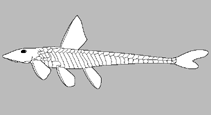
Classification / Noms
Noms communs | Synonymes | Catalog of Fishes(Genre, Espèce) | ITIS | CoL | WoRMS | Cloffa
>
Siluriformes (Catfishes) >
Loricariidae (Armored catfishes) > Hypostominae
Etymology: Hypostomus: Greek, hypo = under + Greek, stoma = mouth (Ref. 45335); heraldoi: Named for Heraldo Antônio Britski, Museu de Zoologia da Universidade de São Paulo, for his extensive contributions to the knowledge of neotropical fish diversity.
Eponymy: Dr Heraldo Antonio Britski is a Brazilian ichthyologist who was awarded a bachelor’s degree (1960) and a doctorate (1973) by Universidade de São Paulo where he is still a researcher, even though he is officially retired. [...] (Ref. 128868), visit book page.
Environnement : milieu / zone climatique / profondeur / gamme de distribution
Écologie
; eau douce démersal. Tropical
South America: Rio Corumbá and rio Grande drainages of the upper rio Paraná basin in Brazil.
Taille / Poids / Âge
Maturité: Lm ? range ? - ? cm
Max length : 23.6 cm SL mâle / non sexé; (Ref. 79067)
Description synthétique
Clés d'identification | Morphologie | Morphométrie
Épines dorsales (Total) : 1; Rayons mous dorsaux (Total) : 7; Épines anales: 1; Rayons mous anaux: 4. Differs from all other species of the genus, except Hypostomus albopunctatus, by having the pectoral fin spine length equal to or smaller than the pelvic-fin spine. Can be differentiated from Hypostomus albopunctatus by the presence of roundish dark spots on body and fins (vs. pale), and generally having more premaxillary, 39-59 per ramus (Ref. 79067).
Body shape (shape guide): elongated.
Facultative air-breathing in the genus (Ref. 126274); Occurs in turbid water and rocky substrate with sand (Ref. 79067). Syntopic with Hypostomus ancistroides, Hypostomus iheringii, Hypostomus margaritifer, and Hypostomus regani (Ref. 79067).
Cycle de vie et comportement reproducteur
Maturité | Reproduction | Frai | Œufs | Fécondité | Larves
Zawadzki, C.H., C. Weber and C.S. Pavanelli, 2008. Two new species of Hypostomus Lacépède (Teleostei: Loricariidae) from the upper rio Paraná basin, Central Brazil. Neotrop. Ichthyol. 6(3):403-412. (Ref. 79067)
Statut dans la liste rouge de l'IUCN (Ref. 130435: Version 2025-2 (Global))
Menace pour l'homme
Harmless
Utilisations par l'homme
Pêcheries: sans intérêt
Outils
Articles particuliers
Télécharger en XML
Sources Internet
Estimations basées sur des modèles
Indice de diversité phylogénétique (Réf.
82804): PD
50 = 0.5000 [Uniqueness, from 0.5 = low to 2.0 = high].
Bayesian length-weight: a=0.01585 (0.00726 - 0.03460), b=2.95 (2.78 - 3.12), in cm total length, based on LWR estimates for this Genus-body shape (Ref.
93245).
Résilience (Réf.
120179): Milieu, temps minimum de doublement de population : 1,4 à 4,4 années (Preliminary K or Fecundity.).
Vulnérabilité de la pêche (Ref.
59153): Low vulnerability (19 of 100).
🛈