Clasificación / Nombres
Nombres comunes | Sinónimos | Catalog of Fishes(Género, Especie) | ITIS | CoL | WoRMS | Cloffa
>
Siluriformes (Catfishes) >
Loricariidae (Armored catfishes) > Loricariinae
Etymology: Loricaria: Latin, lorica, loricare = cuirass of corslet of leather; 1706 + Greek, ichthys = fish (Ref. 45335); lundbergi: Named for Dr. John G. Lundberg, Curator and Chaplin Chair of Ichthyology, Academy of Natural Sciences of Philadelphia, for his leading role in the Calhamazon Project and many outstanding contributions to Neotropical ichthyology.
Eponymy: Dr John Graham Lundberg (d: 1942) is an American ichthyologist. [...] (Ref. 128868), visit book page.
Entorno: milieu / zona climática / rango de profundidad / gama de distribución
Ecología
; agua dulce demersal; rango de profundidad 8 - 19 m (Ref. 79031). Tropical
South America: geagraphically disparate localities in the rio Negro system in Brazil and Venezuela.
Tamaño / Peso / Edad
Madurez: Lm ? range ? - ? cm
Max length : 13.8 cm SL macho / no sexado; (Ref. 79031)
Descripción breve
Claves de identificación | Morfología | Morfometría
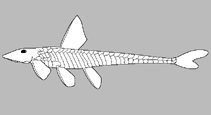
Distinguished from other congeners , except Loricaria parnahybae, by having abdominal plate development confined to the pre-anal shield and posterior median abdominal area, pectoral girdle mostly naked, and with isolated clusters of plates near bases of pectoral fins posterior to gill openings often present in adults (vs. abdominal
plates typically well developed and tightly arranged across the entire median abdominal area, including the pectoral girdle. Can be separated from Loricaria parnahybae by having the following characters: a broader head (17.6-18.4% SL vs. 13.7- 15.8% SL), smaller basicaudal plate (9.0-11.9% vs. 12.9- 15.4% HL), body marked with conspicuous dark saddles and fins with solid dark pigment (vs. body faintly marked with dark saddles and fins with small spots). Differs further from Loricaria simillima by having a smaller basicaudal plate (9.0-11.9% vs. 11.7-23.6% HL). One specimen from rio Mawarinuma of the upper rio Negro drainage differs from specimens collected from deep channel habitats of the rio Negro by having larger and more boldly pigment pattern, larger eye and well developed iris operculum (Ref. 79031).
Body shape (shape guide): elongated.
Facultative air-breathing in the genus (Ref. 126274); Occurs in black-water habitats. Aquatic insect larvae of family Chironomidae, sclerotized body parts of unidentified insect larvae, organic detritus and sand were found in the stomach contents of a single specimen measuring 7.66 cm SL (Ref. 79031).
Ciclo vital y comportamiento de apareamiento
Madurez | Reproducción | Puesta | Huevos | Fecundidad | Larva
Thomas, M.R. and L.H. Rapp Py-Daniel, 2008. Three new species of the armored catfish genus Loricaria (Siluriformes: Loricariidae) from river channels of the Amazon basin. Neotrop. Ichthyol. 6(3):379-394. (Ref. 79031)
Situación en la Lista Roja de la UICN (Ref. 130435: Version 2025-2 (Global))
Amenaza para el ser humano
Harmless
Usos humanos
Pesquerías: sin interés
Herramientas
Informes especiales
Descargar XML
Fuentes de Internet
Estimaciones basadas en modelos
Índice de diversidad filogenética (Referencia
82804): PD
50 = 0.5000 [Uniqueness, from 0.5 = low to 2.0 = high].
Bayesian length-weight: a=0.00398 (0.00185 - 0.00857), b=3.11 (2.93 - 3.29), in cm total length, based on LWR estimates for this (Sub)family-body shape (Ref.
93245).
Nivel trófico (Referencia
69278): 2.5 ±0.2 se; based on size and trophs of closest relatives
Resiliencia (Referencia
120179): Medio, población duplicada en un tiempo mínimo de 1.4-4.4 años (Preliminary K or Fecundity.).
Vulnerabilidad pesquera (Ref.
59153): Low vulnerability (10 of 100).
🛈