Classificazione / Nomi
Nomi Comuni | Sinonimi | Catalog of Fishes(Genere, Specie) | ITIS | CoL | WoRMS | Cloffa
>
Siluriformes (Catfishes) >
Loricariidae (Armored catfishes) > Hypoptopomatinae
Etymology: Hisonotus: Greek, isos = equal + Greek, noton = back (Ref. 45335); armatus: The specific name is derived from the Latin 'arm' (weapon) and 'atus' (armed), in reference to the complete covering of odontodes on the anterior tip of the snout.
More on authors: Carvalho, Lehmann, A. & PereiraReis.
Ambiente: milieu / zona climatica / distribuzione batimetrica / gamma di distribuzione
Ecologia
; acqua dolce demersale. Subtropical
South America: Laguna dos Patos system in Brazil.
Dimensione / Peso / Età
Maturità: Lm ? range ? - ? cm
Max length : 6.0 cm TL maschio/sesso non determinato; (Ref. 111122)
Breve descrizione
Chiavi di identificazione | Morfologia | Morfometria
Distinguished from all other species of Hisonotus, except Hisonotus notatus and Hisonotus leucofrenatus, by having anterior margin of the snout completely covered by
odontodes vs. with a narrow or wide odontode-free; large plates in the abdominal median series, usually comprising one series of plates between the lateral abdominal plates vs. abdominal median series of plates small, with several plate series irregularly arranged
between the lateral abdominal ones. Can be differentiated from Hisonotus notatus and Hisonotus leucofrenatus in the presence on the caudal fin of a series of light hyaline spots, forming a vertical light bar, vs. a rounded hyaline blotch or no hyaline area in the midventral portion of caudal fin (Ref. 78747).
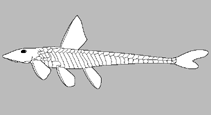
Body shape (shape guide): elongated.
Facultative air-breathing in the genus (Ref. 126274); Occurs in slow to moderate flowing watercourses, with clear to brown water over sandy bottom and in marginal or submerged aquatic vegetation. Sympatric with Hisonotus laevior throughout its distribution (Ref. 78747).
Ciclo vitale e comportamento di accoppiamento
Maturità | Riproduzione | Deposizione | Uova | Fecondità | Larve
Carvalho, T.P., P. Lehmann A., E.H.L. Pereira and R.E. Reis, 2008. A new species of Hisonotus (Siluriformes: Loricariidae: Hypoptopomatinae) from the Laguna dos Patos Basin, Southern Brazil. Copeia 2008(3):510-516. (Ref. 78747)
Stato della Lista Rossa IUCN (Ref. 130435: Version 2025-2 (Global))
Minaccia per l'uomo
Harmless
Usi umani
Strumenti
Rapporti speciali
Scarica XML
Fonti Internet
Stime basate su modelli
Indice di diversità filogenetica (Fonte Biblio.
82804): PD
50 = 0.5000 [Uniqueness, from 0.5 = low to 2.0 = high].
Bayesian length-weight: a=0.00776 (0.00402 - 0.01500), b=3.04 (2.87 - 3.21), in cm total length, based on LWR estimates for this species & (Sub)family-body (Ref.
93245).
Resilienza (Fonte Biblio.
120179): Alto, tempo minimo di raddoppiamento della popolazione meno di 15 mesi (Preliminary K or Fecundity.).
Vulnerabilità della pesca (Ref.
59153): Low vulnerability (10 of 100).
🛈