Klassifizierung / Names
Namen | Synonyme | Catalog of Fishes(Gattung, Arten) | ITIS | CoL | WoRMS | Cloffa
>
Cypriniformes (Carps) >
Cobitidae (Spined loaches)
Etymology: Cobitis: Greek, kobitis, -idos = a kind of sardine; also related with the voice Greek, kobios, Latin gobius = gudgeon (Ref. 45335); taurica: The specific epithet comes from Tauris-Taurida, the ancient Greek and Latin name of the Crimean Peninsula.
Umwelt: Milieu / Klimazone / Tiefenbereich / Verbreitungsgebiet
Ökologie
; süßwasser benthopelagisch. Temperate
Europe: Chornaya River in Crimean Peninsula, Ukraine.
A population known from lower South Bug with similar chromosome characters might represent an unnamed species (Ref. 59043).
Größe / Gewicht / Alter
Geschlechtsreife: Lm ? range ? - ? cm
Max length : 9.7 cm SL Männchen/unbestimmt; (Ref. 75104); 9.2 cm SL (female)
Kurzbeschreibung
Bestimmungsschlüssel | Morphologie | Morphometrie
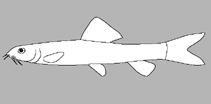
Rückenflossenstacheln (insgesamt) : 2 - 3; Rückenflossenweichstrahlen (insgesamt) : 6 - 8; Afterflossenstacheln: 2 - 3; Afterflossenweichstrahlen: 5 - 6. Distinguished from other species by possessing the following characters: upper part of caudal-fin base with elongated narrow dark spot; males with one lamina Canestrini in the pectoral fin, usually broad, axe-shaped; more or less rounded scales with a relatively small central part devoid of cross furrows; Gambetta’s zones of pigmentation are well developed, the fourth zone with relatively small and low 15-28, usually more than 18 spots whose depth is about two times smaller than the horizontal eye diameter (the largest spots on the caudal peduncle are also noticeably smaller than the horizontal eye diameter); the suborbital spine always reaches the posterior edge of the pupil and usually goes further and in small specimens (with TL less than 6.5 cm), usually reaches the posterior edge of the eye; the outer branch of this spine usually (95.5 %) goes as far as centre of eye and often further; head moderately long and deep with a more or less straight profile; 2n=50 (5 pairs of meta-, 15 pairs of submeta-, 4 pairs of subtelo- and 1 pair of acrocentrics), NF=90 (Ref. 78640).
Body shape (shape guide): elongated.
Found in streams with still to moderately flowing clear water, on sand to silt bottom or in dense vegetation (Ref. 59043). Oviparous, possibly with distinct pairing during breeding similar to congeners (Ref. 205). Population is threatened due to a concentrated distribution in a very limited stretch of stream which might dry up in summer (Ref. 59043). Females grow up to a maximum length of 9.1 SL (Ref. 78640).
Lebenszyklus und Paarungsverhalten
Geschlechtsreife | Fortpflanzung | Ablaichen | Eier | Fruchtbarkeit | Larven
During courtship, 'the male follows the female and, after both enter dense vegetation (e.g. filamentous algae), the male forms a complete ring around the female's body behind the dorsal as the female releases the eggs' (Ref. 59043).
Janko, K., V.P. Vasil'ev, P. Ráb, M. Rábová, V. Slechtová and E.D. Vasil'eva, 2005. Genetic and morphological analyses of 50-chromosome spined loaches (Cobitis, Cobitidae, Pisces) from the Black Sea basin that are morphologically similar to C. taenia, with the description of a new species. Folia Zool. 54(4):405-420. (Ref. 78640)
IUCN Rote Liste Status (Ref. 130435: Version 2025-2 (Global))
Bedrohung für Menschen
Harmless
Nutzung durch Menschen
Tools
Zusatzinformationen
Download XML
Internet Quellen
Schätzungen auf der Grundlage von Modellen
Phylogenetischer Diversitätsindex (Ref.
82804): PD
50 = 0.5000 [Uniqueness, from 0.5 = low to 2.0 = high].
Bayesian length-weight: a=0.00513 (0.00231 - 0.01140), b=3.09 (2.92 - 3.26), in cm total length, based on LWR estimates for this Genus-body shape (Ref.
93245).
Trophische Ebene (Ref.
69278): 3.2 ±0.4 se; based on size and trophs of closest relatives
Widerstandsfähigkeit (Ref.
120179): mittel, Verdopplung der Population dauert 1,4 - 4,4 Jahre. (Assumed Fec<1,000).
Anfälligkeit der Fischerei (Ref.
59153): Low vulnerability (10 of 100).
🛈