>
Blenniiformes (Blennies) >
Chaenopsidae (Pike-, tube- and flagblennies)
Etymology: Emblemariopsis: Latin, emblema = insertion, inlaid work, raised ornament + Greek, opsis = appearance (Ref. 45335); dianae: Named for Diane M. Tyler, Smithsonian Institution Press.
Eponymy: Diane M Tyler was managing editor of the Scientific Contributions Series of the Smithsonian Institution Press. [...] (Ref. 128868), visit book page.
Meio ambiente: milieu / Zona climática / intervalo de profundidade / faixa de distribuição
Ecologia
marinhas associadas(os) a recifes; intervalo de profundidade 0 - 2 m (Ref. 78428). Tropical
Western Central Atlantic: Belize and Honduras.
Tamanho / Peso / Idade
Maturidade: Lm ? range ? - ? cm
Max length : 2.1 cm SL macho/indeterminado; (Ref. 78428)
Descrição suscinta
Chaves de identificação | Morfologia | Morfometria
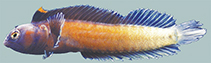
Espinhos dorsais (total) : 18 - 20; Raios dorsais (total) : 10 - 12; Espinhos anais: 2; Raios anais : 19 - 21; Vértebras: 36 - 37. This species is distinguished by the following characters: TP males hav orbital cirrus and a red banner (bright orange flag on the distal one-third to one-fourth of the anterior region of the spinous dorsal fin, with color is mostly confined to between the first and third spines, Ref. 78428). TP territorial males found in holes with a mostly black head, dark-shaded body, and blackened fins, dorsal fin with a distal red band reportedly without a narrow white band below or a thin white margin; first dorsal-fin spine is short, reaching to about 5th spine base when adpressed, about 1/3-1/2 of HL, 8-15% SL, the second spine slightly shorter than first, third spine about equal or slightly shorter than first, the fourth spine about equal to first, tenth spine is longer than first, anterior dorsal fin profile with a shallow concavity (Ref. 125603).
Dark-shaded TP with relatively short first dorsal-fin spines and a red band, absence of opercular bands or lines, discrete rows of dark spots on dorsal-fin membranes and the dark spots along lateral midline or above midline (Ref. 125603).
IP with short first two dorsal-fin spines, with first spine reaching to base of 5th-6th spine base when adpressed, the second slightly shorter, third 3/4 of first, the middle-fin spines longer than anterior spines; live colors and cranial (Ref. 125603).
Body shape (shape guide): elongated; Cross section: oval.
Prefers the low-energy habitats of protected mid-shelf reefs in Belize, with TP preferring holes in dead coral substrates, most often the coiled shells of dead vermetid gastropods. All specimens were collected in less than 5 m depth, with the single IP Honduran specimen collected on the lee side of Utila in a relatively protected area, in less than 5 m depth (Ref. 78428).
Ciclo de vida ou comportamento de acasalamento
Maturidade | Reprodução | Desova | Ovos | Fecundidade | Larvas
Victor, B.C., 2020. Review of the glass blennies (Teleostei: Chaenopsidae: Emblemariopsis) with two new species from the Caribbean Sea. J. Ocean Sci. Found. 37:1-122. (Ref. 125603)
Status na Lista Vermelha da UICN (Ref. 130435: Version 2025-2 (Global))
Ameaça para os humanos
Harmless
Uso pelos humanos
Ferramentas
Relatórios especiais
Baixar XML
Fontes da internet
Estimativas baseadas em modelos
Índice de diversidade filogenética (Ref.
82804): PD
50 = 0.5001 [Uniqueness, from 0.5 = low to 2.0 = high].
Bayesian length-weight: a=0.00525 (0.00224 - 0.01232), b=3.07 (2.86 - 3.28), in cm total length, based on LWR estimates for this (Sub)family-body shape (Ref.
93245).
Nível Trófico (Ref.
69278): 3.1 ±0.4 se; based on size and trophs of closest relatives
Vulnerabilidade da pesca (Ref.
59153): Low vulnerability (10 of 100).
🛈