Classification / Noms
Noms communs | Synonymes | Catalog of Fishes(Genre, Espèce) | ITIS | CoL | WoRMS | Cloffa
>
Cypriniformes (Carps) >
Leuciscidae (Minnows) > Leuciscinae
Eponymy: The etymology is not explained by Bonaparte, and it may not be an eponym. However, Telestes was the name of the last king of ancient Corinth (748 BC) and of a poet of 5th-century Greece, so the name might refer to one of these. (Ref. 128868), visit book page.
More on author: Risso.
Environnement : milieu / zone climatique / profondeur / gamme de distribution
Écologie
; eau douce benthopélagique. Temperate; 10°C - 20°C (Ref. 2059); 49°N - 41°N, 4°E - 19°E
Europe: Mediterranean basin from Aude to Var drainages (France, Switzerland); literature records from Tarn system [Garonne drainage] in fact refers to Hérault [each has a tributary named Dourbie]; Soca drainage in Italy and Slovenia; uppermost Rhine drainage in Germany and Switzerland; Danube drainage in western tributaries of Germany, Austria, Slovenia, Croatia and part of Bosnia-Herzegovina, and upper Tisza system (Romania, Ukraine). Record from Aegean basin in Bulgaria based on misidentification of a possibly unnamed species. Introgression zone with Telestes muticellus in Var drainage (France) and Soca drainage (Slovenia, Italy). Telestes souffia agassii is often applied to Danube and Rhine populations, but there is no published evidence that they differ from the Rhône populations. If justified, the correct name for a Danube-Rhine species would be Telestes rysela and not Telestes agassii.
Taille / Poids / Âge
Maturité: Lm ? range ? - ? cm
Max length : 25.0 cm TL mâle / non sexé; (Ref. 556); common length : 15.0 cm TL mâle / non sexé; (Ref. 556)
Description synthétique
Clés d'identification | Morphologie | Morphométrie
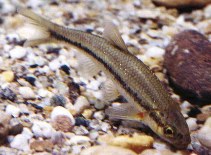
Épines dorsales (Total) : 2 - 3; Rayons mous dorsaux (Total) : 7 - 9; Épines anales: 3; Rayons mous anaux: 9 - 10; Vertèbres: 41 - 42. Diagnosed from its congeners by having the following characters: conspicuous black midlateral stripe and conspicuous black line along lateral line in preserved individuals; in life, broad gold-orange stripe; lateral line yellow, bordered on each side by a narrow black line; 44-57 + 2-3 scales along lateral line (usually 50-57 + 2-3); 4½-5 scale rows between lateral line and pelvic fin origin; anal fin usually with 9½ branched rays; snout tip rounded or blunt, snout projecting beyond tip of upper lip; and eye diameter 4.0-4.6 times in HL (Ref. 59043). Caudal fin with 17 to 21 rays (Ref. 40476).
Body shape (shape guide): elongated.
Adults inhabit middle reaches of streams and rivers with clear water, moderately swift current and gravel bottom. Occurs in groups. They feed on invertebrates and algae. Breeding occurs in fast-flowing water on gravel bottom (Ref. 59043). Used as bait. Not so well fished although the flesh is excellent (Ref. 30578). Locally threatened (Ref. 59043).
Cycle de vie et comportement reproducteur
Maturité | Reproduction | Frai | Œufs | Fécondité | Larves
Kottelat, M. and J. Freyhof, 2007. Handbook of European freshwater fishes. Publications Kottelat, Cornol and Freyhof, Berlin. 646 pp. (Ref. 59043)
Statut dans la liste rouge de l'IUCN (Ref. 130435: Version 2025-2 (Global))
Menace pour l'homme
Harmless
Utilisations par l'homme
Pêcheries: sans intérêt; Aquarium: Aquariums publics
Outils
Articles particuliers
Télécharger en XML
Sources Internet
Estimations basées sur des modèles
Indice de diversité phylogénétique (Réf.
82804): PD
50 = 0.5000 [Uniqueness, from 0.5 = low to 2.0 = high].
Bayesian length-weight: a=0.00832 (0.00390 - 0.01775), b=3.09 (2.91 - 3.27), in cm total length, based on LWR estimates for this (Sub)family-body shape (Ref.
93245).
Niveau trophique (Réf.
69278): 3.4 ±0.42 se; based on food items.
Résilience (Réf.
120179): Milieu, temps minimum de doublement de population : 1,4 à 4,4 années (tm=3).
Vulnérabilité de la pêche (Ref.
59153): Low vulnerability (15 of 100).
🛈