Clasificación / Nombres
Nombres comunes | Sinónimos | Catalog of Fishes(Género, Especie) | ITIS | CoL | WoRMS | Cloffa
>
Blenniiformes (Blennies) >
Tripterygiidae (Triplefin blennies) > Tripterygiinae
Etymology: Helcogramma: Greek, helkos, -eos, -ous = ulcer, sore + Greek, gramma = letter, mark (Ref. 45335); rharhabe: Named after Rharhabe a paramount chief from 1775 to 1787. The name is treated as a noun in apposition.
Eponymy: Rharhabe (ca: 1715–c. [...] (Ref. 128868), visit book page.
Entorno: milieu / zona climática / rango de profundidad / gama de distribución
Ecología
marino bentopelágico; rango de profundidad 0 - 3 m (Ref. 75031). Tropical
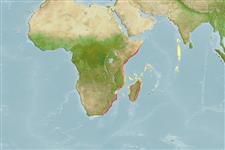
Western Indian and Southeast Atlantic: from Mozambique (Bazaruto) to South Africa. Speciimens collected from Shimoni, Kenya may refer to the species but are in poor condition so until additional specimens are available, Bazaruto is considered its most northern limit (Ref. 75031).
Tamaño / Peso / Edad
Madurez: Lm ? range ? - ? cm
Max length : 3.7 cm SL macho / no sexado; (Ref. 75031)
Descripción breve
Claves de identificación | Morfología | Morfometría
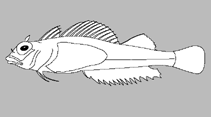
Espinas dorsales (total) : 10 - 17; Radios blandos dorsales (total) : 10 - 11; Espinas anales: 1; Radios blandos anales: 19; Vértebra: 34 - 35. Diagnosis: Medium to large species of the genus. Dorsal fin III + XIII+ 10, 2nd fin twice the 1st; anal fin I, 19; pectoral rays 16 (1+8+7); pelvic fin I, 2, spine short and hidden, segmented rays simple, partially united by membrane. Vertebrae 10+24-25. LL total lateral scales 37-38; tubed 21-31 (geographically variant means), ends below junction of 2nd and 3rd dorsal fin; nape, belly, 1st dorsal fin and anterior anal-fin bases scaleless, caudal-fin base with 2 rows of scales. Mandibular pores 5+1+5. Orbital cirrus simple and small. Head length 3.3-3.7 in SL; eye 2.6-3.2, maxilla 2.2-2.6 in HL. Males body with red and black spots evenly scattered, vertical stripes from dorsal fin to midline of side, and silvery spots below midline; head with blue stripe from mouth corner to preopercle, upperlip corner with crimson markings, black in the center (Ref. 75031).
Body shape (shape guide): elongated.
Female members of the Tripterygiidae have eggs that are hemispherical and covered with numerous sticky threads that anchor them in the algae on the nesting sites (Ref. 240). Larvae are planktonic which occur primarily in shallow, nearshore waters (Ref. 94114).
Ciclo vital y comportamiento de apareamiento
Madurez | Reproducción | Puesta | Huevos | Fecundidad | Larva
Holleman, W., 2007. Fishes of the genus Helcogramma (Blennioidei: Tripterygiidae) in the Western Indian Ocean, including Sri Lanka, with description of four new species. Smith. Bull. 7:51-81. (Ref. 75031)
Situación en la Lista Roja de la UICN (Ref. 130435: Version 2025-2 (Global))
Amenaza para el ser humano
Usos humanos
Herramientas
Informes especiales
Descargar XML
Fuentes de Internet
Estimaciones basadas en modelos
Temperatura preferida (Referencia
123201): 22.4 - 27.5, mean 26.8 °C (based on 194 cells).
Índice de diversidad filogenética (Referencia
82804): PD
50 = 0.5000 [Uniqueness, from 0.5 = low to 2.0 = high].
Bayesian length-weight: a=0.00617 (0.00290 - 0.01310), b=3.04 (2.86 - 3.22), in cm total length, based on LWR estimates for this (Sub)family-body shape (Ref.
93245).
Nivel trófico (Referencia
69278): 3.1 ±0.3 se; based on size and trophs of closest relatives
Resiliencia (Referencia
120179): Alto, población duplicada en un tiempo mínimo inferior a 15 meses (Preliminary K or Fecundity.).
Vulnerabilidad pesquera (Ref.
59153): Low vulnerability (10 of 100).
🛈