Klassifizierung / Names
Namen | Synonyme | Catalog of Fishes(Gattung, Arten) | ITIS | CoL | WoRMS | Cloffa
>
Pleuronectiformes (Flatfishes) >
Soleidae (Soles)
Etymology: Aseraggodes: Greek, aggos, -eos, -ous = vessel, uterus, carapace of a crab + Greek, aseros, -a, -on = to remove the appetite (Ref. 45335); cheni: Named for Dr. Jeng-Ping Chen of the National Museum of Marine Biology
and Aquarium (southern Taiwan), who collected and photographed the holotype (Ref. 74405).
Eponymy: Dr Jen-Ping Chen is an ichthyologist who works at the National Taiwan University, Taipei, where he is a Full Professor and at the Institute of Zoology of Academia Sinica, National Museum of Marine Biology and Aquarium, Taiwan. [...] (Ref. 128868), visit book page.
More on authors: Randall & Senou.
Umwelt: Milieu / Klimazone / Tiefenbereich / Verbreitungsgebiet
Ökologie
seewasser riff-verbunden; tiefenbereich 14 - 48 m (Ref. 74405). Subtropical
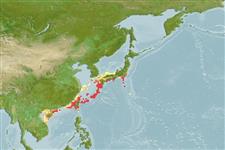
Northwest Pacific: Taiwan and Japan
Größe / Gewicht / Alter
Geschlechtsreife: Lm ? range ? - ? cm
Max length : 7.5 cm SL Männchen/unbestimmt; (Ref. 74405)
Kurzbeschreibung
Bestimmungsschlüssel | Morphologie | Morphometrie
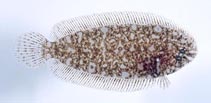
Rückenflossenweichstrahlen (insgesamt) : 68 - 75; Afterflossenweichstrahlen: 46 - 51. This species is distinguished by the following characters: D 68-75; A 46-51, all branched; 73-76 lateral-line scales; 36-38 vertebrae; dorsal pterygiophores anterior to 4th neural spine 13 or 14 (only 1 with 13); body depth 2.45-2.65 SL; head length 4.5-4.65 SL; caudal-peduncle length 7.7 8.2 in head length; snout length 2.4-2.65 in head length; preorbital length 2.4-2.5 in head length; eye diameter 4.65-5.25 in head length; interorbital space narrow, 11.1-14.4 in head length; tubular anterior nostril reaching edge of eye when depressed posteriorly; longest dorsal ray 1.6-1.9 in head length; caudal fin 3.15-3.55 SL; pelvic fins reaching or nearly reaching base of 4th anal ray, 1.65-1.75 in head length, 9-16 cteni on scales, not projecting very far beyond scale margins; front edge of snout and ventral edge of head with 2 rows of lappet-like cirri; color when fresh light brown with irregular white and dark brown markings, a few white ones forming broken circles, while dark brown ones may border or partly encircle the white; 2 prominent white bands on snout and 3 extending downward from lower eye; fin rays with small dark brown spots (Ref. 74405).
Body shape (shape guide): short and / or deep.
Lebenszyklus und Paarungsverhalten
Geschlechtsreife | Fortpflanzung | Ablaichen | Eier | Fruchtbarkeit | Larven
Randall, J.E. and H. Senou, 2007. Two new soles of the genus Aseraggodes (Pleuronectiformes: Soleidae) from Taiwan and Japan. Zool. Stud. 46(3):303-310. (Ref. 74405)
IUCN Rote Liste Status (Ref. 130435: Version 2025-2 (Global))
Nutzung durch Menschen
Tools
Fatal error: Uncaught mysqli_sql_exception: Too many connections in /var/www/html/includes/speciessummary.lib.php:1888
Stack trace:
#0 /var/www/html/includes/speciessummary.lib.php(1888): mysqli->__construct('mysql', 'fbuser', Object(SensitiveParameterValue), 'fbquizv2', '3306')
#1 /var/www/html/summary/SpeciesSummary.php(1851): checkRecordDisplayFBQuizV2('64596', 'PicList')
#2 {main}
thrown in /var/www/html/includes/speciessummary.lib.php on line 1888