Classificazione / Nomi
Nomi Comuni | Sinonimi | Catalog of Fishes(Genere, Specie) | ITIS | CoL | WoRMS | Cloffa
>
Anabantiformes (Gouramies, snakeheads) >
Osphronemidae (Gouramies) > Macropodusinae
Etymology: Betta: Malay/Javanese origin. Bleeker (1850, 1858) indicates Ikan Wadder Bettah as the local name of Betta trifasciata Bleeker, 1849 (now Betta picta, Valenciennes, 1846) in the Ambarawa Javanese dialect. Ikan Wader is a common Javanese name for smaller freshwater fishes, especially cyprinids (already used in Old Javanese). See Blust, R. & Trussel, S. Austronesian Comparative Dictionary. Web Edition (https://www.trussel2.com/acd/); apollon: Named for Apollo, the mythological Greek god of (among others) music, poetry, medicine and archery and which also refers to handsome young man; an allusion to the beautiful appearance of this species.
Ambiente: milieu / zona climatica / distribuzione batimetrica / gamma di distribuzione
Ecologia
; acqua dolce pelagico. Tropical
Asia: Thailand.
Dimensione / Peso / Età
Maturità: Lm ? range ? - ? cm
Max length : 5.1 cm SL maschio/sesso non determinato; (Ref. 78499)
Breve descrizione
Chiavi di identificazione | Morfologia | Morfometria
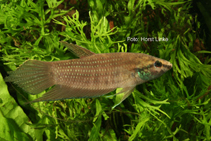
Spine dorsali (totale) : 1; Raggi dorsali molli (totale) : 8 - 9; Spine anali: 2 - 3; Raggi anali molli: 23 - 24. This species belonging to the Betta pugnax group is differentiated from the others by having the following characters: elongated last branchiostegal ray extending beyond
posterior margin of the operculum; 25-26 total anal-fin rays; 29-30 lateral scales (Ref. 78499).
Body shape (shape guide): fusiform / normal.
Facultative air-breathing (Ref. 126274); This species was collected in hill-streams strongly shaded by forest; mostly found in shallow water close to the shores between roots, plants or leaf litter. Some specimens were also collected from the swift flowing area between boulders. Water data from the type locality: colourless, clear and with a pH of 6.2, an electric conductivity of 20-40 µS/cm and a temperature of 24-26 °C (Ref. 78499).
Ciclo vitale e comportamento di accoppiamento
Maturità | Riproduzione | Deposizione | Uova | Fecondità | Larve
Schindler, I. and J. Schmidt, 2006. Review of the mouthbrooding Betta (Teleostei, Osphronemidae) from Thailand, with descriptions of two new species. Zeitschrift für Fischkunde 8(1/2):47-69. (Ref. 78499)
Stato della Lista Rossa IUCN (Ref. 130435: Version 2025-2 (Global))
Minaccia per l'uomo
Harmless
Usi umani
Pesca: di nessun interesse
Strumenti
Rapporti speciali
Scarica XML
Fonti Internet
Stime basate su modelli
Indice di diversità filogenetica (Fonte Biblio.
82804): PD
50 = 0.5000 [Uniqueness, from 0.5 = low to 2.0 = high].
Bayesian length-weight: a=0.01000 (0.00374 - 0.02675), b=2.97 (2.74 - 3.20), in cm total length, based on LWR estimates for this (Sub)family-body shape (Ref.
93245).
Livello trofico (Fonte Biblio.
69278): 3.2 ±0.4 se; based on size and trophs of closest relatives
Resilienza (Fonte Biblio.
120179): Alto, tempo minimo di raddoppiamento della popolazione meno di 15 mesi (Preliminary K or Fecundity.).
Vulnerabilità della pesca (Ref.
59153): Low vulnerability (10 of 100).
🛈