>
Ovalentaria/misc (Various families in series Ovalentaria) >
Opistognathidae (Jawfishes)
Etymology: Opistognathus: Greek, opisthe = behind + Greek, gnathos = jaw (Ref. 45335); to the very elongate upper jaw of the type species of the genus, Opistognathus nigromarginatus (Ref. 128653); rufilineatus: - Name from Latin ‘rufus’ for reddish and ‘lineatus’ for line’ referring to the striped color pattern of the species.
Environnement : milieu / zone climatique / profondeur / gamme de distribution
Écologie
marin démersal; profondeur 2 - 35 m (Ref. 90102). Tropical
Western Pacific: Indonesia.
Taille / Poids / Âge
Maturité: Lm ? range ? - ? cm
Max length : 7.9 cm TL mâle / non sexé; (Ref. 90102)
Description synthétique
Clés d'identification | Morphologie | Morphométrie
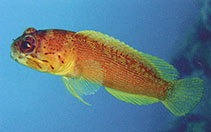
Épines dorsales (Total) : 11; Rayons mous dorsaux (Total) : 11; Épines anales: 2; Rayons mous anaux: 10; Vertèbres: 26. This species is distinguished by the following characters: upper jaw extending about 0.7-0.9 eye diameters behind posterior margin of orbit, the maxilla widest at end, without a flexible lamina posteriorly; D XI,11; A II,10. Colouration: body generally yellowish brown, slightly darker on back, with narrow red-brown stripes outlining each yellow-tan lateral scale row and fins without dark spots are distinctive markings; cheeks with a few scattered, small, dark, brown spots, also with narrow oblique lines; posterior infraorbital pore positions occupied by multiple pores; most preopercular pore positions bi-pored (Ref. 75148).
Body shape (shape guide): elongated; Cross section: oval.
Specimens were collected on the edge of a 200 m-wide channel between the mainland and a small island, where the area is exposed to periodic strong currents associated with tidal fluctuation. It is characterized by relatively rich coral grading to rubble in deeper water with a maximum depth of about 50 m. It has a series of vents, at depths of about 2-35 m, which releases large volumes of freshwater and the abrupt salinity changes are visible due to the blurring effect of the fresh- and seawater mixture. About 10 burrows of this species were detected on rubble bottoms in about 20-25 m depth during the 2006 and 2007 visits. The two type specimens were taken from their burrows using a clove oil-alcohol solution (Ref. 75148).
Cycle de vie et comportement reproducteur
Maturité | Reproduction | Frai | Œufs | Fécondité | Larves
Smith-Vaniz, W.F. and G.R. Allen, 2007. Opistognathus rufilineatus, a new species of jawfish (Opistognathidae) from the Bird's Head Peninsula, western New Guinea. aqua, Int. J. Ichthyol. 13(1):35-42. (Ref. 75148)
Statut dans la liste rouge de l'IUCN (Ref. 130435: Version 2025-2 (Global))
Utilisations par l'homme
Pêcheries: sans intérêt
Outils
Articles particuliers
Télécharger en XML
Sources Internet
Estimations basées sur des modèles
Indice de diversité phylogénétique (Réf.
82804): PD
50 = 0.5000 [Uniqueness, from 0.5 = low to 2.0 = high].
Bayesian length-weight: a=0.00389 (0.00180 - 0.00842), b=3.12 (2.94 - 3.30), in cm total length, based on all LWR estimates for this body shape (Ref.
93245).
Niveau trophique (Réf.
69278): 3.4 ±0.5 se; based on size and trophs of closest relatives
Vulnérabilité de la pêche (Ref.
59153): Low vulnerability (10 of 100).
🛈