>
Gobiiformes (Gobies) >
Gobiidae (Gobies) > Gobiinae
Etymology: Eviota: No etymology given, suggested by Christopher Scharpt: from Latin 'eu' for 'true' and 'iota' for anything very small, in combination 'truly very small' referring to it as being the smallest vertebrate at the time it has benn described by Jenkins (thus, making the suggestion by Scharpt plausible; masudai: Named after Hajime Masuda (Ref. 76829).
Eponymy: Hajime Masuda (1921–2005) was a Japanese ichthyologist. [...] (Ref. 128868), visit book page.
Environnement : milieu / zone climatique / profondeur / gamme de distribution
Écologie
marin récifal; profondeur 2 - 64 m (Ref. 76829). Temperate
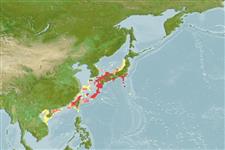
Northwest Pacific: Japan, also Ogasawara and Ryukyu Islands.
Taille / Poids / Âge
Maturité: Lm ? range ? - ? cm
Max length : 3.2 cm SL mâle / non sexé; (Ref. 76829); 2.7 cm SL (female)
Description synthétique
Clés d'identification | Morphologie | Morphométrie
Épines dorsales (Total) : 6 - 7; Rayons mous dorsaux (Total) : 9 - 10; Épines anales: 1; Rayons mous anaux: 9. This species is distinguished by the following characters: D VI-I, 10 (9 in only one paratype); typical males (11 of 14 males) have elongate and filamentous dorsal spines reaching to anterior 4th to 8th soft rays of second dorsal fin; A I, 13; pectoral rays 17-18; including 13-17 branched rays; pelvic rays I, 4, I (fifth ray absent in 2 paratypes), fifth pelvic ray greatly reduced, averaging 14.1% (7.0%-28.0%) of fourth ray length, well developed pelvic-fin membranes extending beyond base of first branch of each pelvic-fin ray; lateral scale rows 23-25; transverse scale rows 6-8; cephalic sensory pore system complete sensu Lachner & Karnella (1980); genital papillae of males non-fimbriate; body light pink; edge of scale pockets reddish brown or brown; forming network on body; a small round bluish black or dark brown blotch on each side of nape just above opercle; 2 short longitudinal reddish brown or brown lines on cheek; the upper running posteriorly from postero-ventral corner of eye to a point midway between eye and posterior end of opercle, the lower line running from corner of mouth to a vertical line through posterior edge of eye; a short longitudinal reddish or dark brown line on anteroventral part of preopercle, just below the lower line on cheek; 2 short longitudinal reddish brown or brown bars or oval blotches on pectoral-fin base; one each on the dorsal and ventral part (Ref. 76829).
Body shape (shape guide): fusiform / normal.
Occurs in shallow rocky reefs (Ref. 76829).
Cycle de vie et comportement reproducteur
Maturité | Reproduction | Frai | Œufs | Fécondité | Larves
Matsuura, K. and H. Senou, 2006. Eviota masudai, a new gobiid fish (Teleostei: Perciformes) from Japan. Mem. Natl. Sci. Mus. (41):341-349. (Ref. 76829)
Statut dans la liste rouge de l'IUCN (Ref. 130435: Version 2025-2 (Global))
Utilisations par l'homme
Outils
Articles particuliers
Télécharger en XML
Sources Internet
Estimations basées sur des modèles
Température préférée (Réf.
123201): 17.4 - 25.2, mean 21.3 °C (based on 52 cells).
Indice de diversité phylogénétique (Réf.
82804): PD
50 = 0.5000 [Uniqueness, from 0.5 = low to 2.0 = high].
Bayesian length-weight: a=0.01023 (0.00477 - 0.02194), b=3.01 (2.83 - 3.19), in cm total length, based on LWR estimates for this (Sub)family-body shape (Ref.
93245).
Niveau trophique (Réf.
69278): 3.1 ±0.3 se; based on size and trophs of closest relatives
Résilience (Réf.
120179): Haut, temps minimum de doublement de population inférieur à 15 mois (Preliminary K or Fecundity.).
Vulnérabilité de la pêche (Ref.
59153): Low vulnerability (10 of 100).
🛈