Classificazione / Nomi
Nomi Comuni | Sinonimi | Catalog of Fishes(Genere, Specie) | ITIS | CoL | WoRMS | Cloffa
>
Cichliformes (Cichlids, convict blennies) >
Cichlidae (Cichlids) > Geophaginae
Etymology: Gymnogeophagus: Greek, gymnos = naked + Greek, gea = the earth + Greek, phaegein, to eat (Ref. 45335); caaguazuensis: Named for the province of Caaguazú, Paraguay, the area of occurrence of the new species; an adjective, masculine form.
Ambiente: milieu / zona climatica / distribuzione batimetrica / gamma di distribuzione
Ecologia
; acqua dolce benthopelagico. Tropical
South America: Paraguay.
Dimensione / Peso / Età
Maturità: Lm ? range ? - ? cm
Max length : 8.6 cm SL maschio/sesso non determinato; (Ref. 78439)
Breve descrizione
Chiavi di identificazione | Morfologia | Morfometria
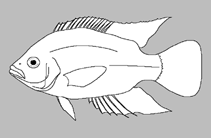
This small mouthbrooding species possess the following characters: a conspicuous secondary sexual dimorphism; differs from its congeners in having a body that is comparatively deep, short caudal peduncle, lyreate caudal fin of males, scales in E1 row 26-28, and its small size, maximum length 8.63 cm SL (Ref. 78439).
Body shape (shape guide): short and / or deep.
Prefers habitats that are bare sandy bottoms among rocky areas in small rivulets which may have a strong current during the rainy season. During the dry season and period of low water, this species is found in pools and ponds with more or less stagnant water. In February, water data collected at the type locality has pH 7.9; electrical conductivity 240 μS/cm; temperature 24.2 °C. Associated fish fauna included Phalloceros caudimaculatus (Poeciliidae), Rineloricaria sp. (Loricariidae) and two small characid species. This species displays a variety of parental care and mating systems ranging from mouthbrooding and polygyny to substrate spawning and monogamy. In the aquarium, breeding was observed and the species was azuensis found to be a delayed (larvophile) maternal mouthbrooder, where like several of its congeners, it starts reproduction like a substrate spawner, i. e. the parents initially spawn on a stone, but just prior to the hatching of the larvae the female picks up the eggs and then orally broods the larvae and young. Courting males, in from of ripe females, display a conspicuous quivering movement of their mouths caused by opening and closing the mouth with extremely high frequency and this peculiar behaviour during courtship seems to be a synapomorphy of the mouthbrooding species, as it has been observed only within this species complex (Ref. 78439).
Ciclo vitale e comportamento di accoppiamento
Maturità | Riproduzione | Deposizione | Uova | Fecondità | Larve
Staeck, W., 2006. Gymnogeophagus caaguazuensis sp. n. - a new species of cichlid fish (Teleostei: Perciformes: Cichlidae) from the drainage of the lower río Paraguay in Paraguay. Zoologische Abhandlungen (Dresden) 56:99-105. (Ref. 78439)
Stato della Lista Rossa IUCN (Ref. 130435: Version 2025-2 (Global))
Minaccia per l'uomo
Harmless
Usi umani
Pesca: di nessun interesse
Strumenti
Rapporti speciali
Scarica XML
Fonti Internet
Stime basate su modelli
Indice di diversità filogenetica (Fonte Biblio.
82804): PD
50 = 0.5000 [Uniqueness, from 0.5 = low to 2.0 = high].
Bayesian length-weight: a=0.02399 (0.01144 - 0.05029), b=3.01 (2.83 - 3.19), in cm total length, based on LWR estimates for this (Sub)family-body shape (Ref.
93245).
Livello trofico (Fonte Biblio.
69278): 3.3 ±0.5 se; based on size and trophs of closest relatives
Resilienza (Fonte Biblio.
120179): Alto, tempo minimo di raddoppiamento della popolazione meno di 15 mesi (Preliminary K or Fecundity.).
Vulnerabilità della pesca (Ref.
59153): Low vulnerability (10 of 100).
🛈