Classificazione / Nomi
Nomi Comuni | Sinonimi | Catalog of Fishes(Genere, Specie) | ITIS | CoL | WoRMS | Cloffa
>
Scombriformes (Mackerels) >
Chiasmodontidae (Snaketooth fishes)
Etymology: Pseudoscopelus: Greek, pseudes = false + Greek, skopelos = a lantern fish (Ref. 45335). Lütken did not recognize the presence of photophores on the body, confusing them with pores, but referred to a genus of lanternfish (Scopelus now Myctophum) when he named the genus (Ref. 85782).
Ambiente: milieu / zona climatica / distribuzione batimetrica / gamma di distribuzione
Ecologia
marino batidemersale; distribuzione batimetrica 250 - 1250 m (Ref. 78617). Deep-water
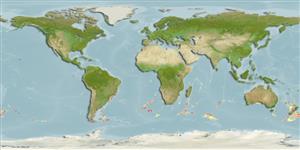
Southern Oceans. Subtropical and temperate waters of the southern parts of the Atlantic and Indian Oceans, Southwestern and Southeastern Pacific.
Dimensione / Peso / Età
Maturità: Lm ? range ? - ? cm
Max length : 17.0 cm SL maschio/sesso non determinato; (Ref. 78617)
Breve descrizione
Chiavi di identificazione | Morfologia | Morfometria
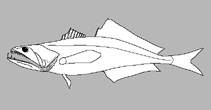
Spine dorsali (totale) : 7 - 10; Raggi dorsali molli (totale) : 23 - 26; Raggi anali molli: 23 - 26. This species is characterized by the following: dark orobranchial cavity; inclined teeth in the marginal row on the premaxillary are increased in size in the postorbital portion of the bone; presence of teeth on tongue; minute gill rakers usually absent on first gill arch; reduced maxillary (suborbital) photophores disconnected with anteropreopercular photophores; no posteropreopercular photophores and transverse ventral (interventral) photophores; thin cranial roofing bones; short upper jaw, 60.0-71.4% head length (HL), usually less than 66% HL (75% of specimens; mean 65.6%); short pectoral fins, 12.5-21.4% SL, usually less than 16% (88% of specimens; mean 14.9%); group of 4 pores above the second nare; modally 36 vertebrae (Ref. 78617).
Body shape (shape guide): elongated.
Ciclo vitale e comportamento di accoppiamento
Maturità | Riproduzione | Deposizione | Uova | Fecondità | Larve
Prokofiev, A.M. and E.I. Kukuev, 2006. Two new species of linebellies (Genus Pseudoscopelus) with a revised key of species (Perciformes: Chiasmodontidae). J. Ichthyol 46 (Suppl. 1):S21-S37. (Ref. 78617)
Stato della Lista Rossa IUCN (Ref. 130435: Version 2025-2 (Global))
Usi umani
Pesca: bycatch
Strumenti
Rapporti speciali
Scarica XML
Fonti Internet
Stime basate su modelli
Temperatura preferita (Fonte Biblio.
123201): 1.4 - 6.5, mean 2.3 °C (based on 32 cells).
Indice di diversità filogenetica (Fonte Biblio.
82804): PD
50 = 0.5000 [Uniqueness, from 0.5 = low to 2.0 = high].
Bayesian length-weight: a=0.00389 (0.00180 - 0.00842), b=3.12 (2.94 - 3.30), in cm total length, based on all LWR estimates for this body shape (Ref.
93245).
Livello trofico (Fonte Biblio.
69278): 3.7 ±0.2 se; based on size and trophs of closest relatives
Vulnerabilità della pesca (Ref.
59153): Low vulnerability (11 of 100).
🛈