Classificazione / Nomi
Nomi Comuni | Sinonimi | Catalog of Fishes(Genere, Specie) | ITIS | CoL | WoRMS | Cloffa
>
Eupercaria/misc (Various families in series Eupercaria) >
Callanthiidae (Splendid perches)
Etymology: Grammatonotus: Greek, gramma, atos = signal, mark + Greek, noton = back (Ref. 45335); ambiortus: Name from Greek ambiortus meaning standing simultaneously at two sites that reflects the presence in it of characters of the genera Grammatonotus and Callanthias (Ref. 78438).
Ambiente: milieu / zona climatica / distribuzione batimetrica / gamma di distribuzione
Ecologia
marino pelagic-oceanic. Tropical
Eastern Central Pacific: Hawaii.
Dimensione / Peso / Età
Maturità: Lm ? range ? - ? cm
Max length : 12.0 cm SL maschio/sesso non determinato; (Ref. 78438)
Breve descrizione
Chiavi di identificazione | Morfologia | Morfometria
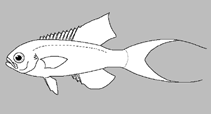
Spine dorsali (totale) : 11; Raggi dorsali molli (totale) : 9; Spine anali: 3; Raggi anali molli: 9; Vertebre: 24. This species possess the following characters: caudal peduncle with 17 main rays; no separate hypurale-5; eye large comparable to postorbital head length, 2.5 times lc; comparatively large teeth in jaws with multiserial teeth on praemaxillare (Ref. 78438).
Body shape (shape guide): fusiform / normal.
Ciclo vitale e comportamento di accoppiamento
Maturità | Riproduzione | Deposizione | Uova | Fecondità | Larve
Prokofiev, A.M., 2006. Grammatonotus ambiortus sp. nova: a new species of callanthiids (Perciformes) from the Western tropical Pacific. J. Ichthyol. 46(1):13-17. (Ref. 78438)
Stato della Lista Rossa IUCN (Ref. 130435: Version 2025-2 (Global))
Minaccia per l'uomo
Harmless
Usi umani
Strumenti
Rapporti speciali
Scarica XML
Fonti Internet
Stime basate su modelli
Indice di diversità filogenetica (Fonte Biblio.
82804): PD
50 = 0.5010 [Uniqueness, from 0.5 = low to 2.0 = high].
Bayesian length-weight: a=0.00977 (0.00377 - 0.02533), b=3.07 (2.85 - 3.29), in cm total length, based on LWR estimates for this (Sub)family-body shape (Ref.
93245).
Livello trofico (Fonte Biblio.
69278): 3.3 ±0.4 se; based on size and trophs of closest relatives
Vulnerabilità della pesca (Ref.
59153): Low vulnerability (10 of 100).
🛈