Classificatie / Namen
Lokale namen | Synoniemen | Catalog of Fishes(Genus, Soort(en)) | ITIS | CoL | WoRMS | Cloffa
>
Ophidiiformes (Cusk eels) >
Dinematichthyidae (Viviparous brotula)
Etymology: Zephyrichthys: Name from Latin 'zephyrus' for west wind, refers to the distribution along the west Australian coast; noun in apposition; barryi: Named for J. Barry Hutchins, WAM, Perth, Australia.
Eponymy: Dr J Barry Hutchins (d: 1946) was Curator of Fishes at the Western Australian Museum (1998–2007), which he joined as a Technical Officer (1972) and where he worked until he retired. [...] (Ref. 128868), visit book page.
More on authors: Schwarzhans & Møller.
Milieu: milieu / Klimaatzone / Diepte / verspreidingsgebied
Ecologie
marien demersaal; diepte 0 - 15 m (Ref. 76869). Tropical
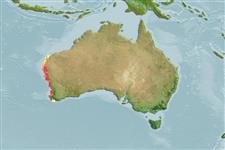
Eastern Indian Ocean: Western Australia.
Grootte / Gewicht / Leeftijd
Maturiteit: Lm ? range ? - ? cm
Max length : 5.9 cm SL mannelijk / geslacht onbekend; (Ref. 76869); 7.0 cm SL (female)
Korte beschrijving
Determinatiesleutels | Morfologie | Morfometrie
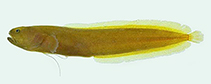
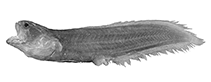
Dorsale zachte stralen (totaal) : 86 - 99; Anale zachte stralen: 67 - 77; Wervels: 43 - 46. This species is distinguished by following set of characters: Anterior nostril positioned low on snout; copulatory organ of male with 2 pairs of pseudoclaspers, the outer one is wing-shaped with broad base, the inner one about half the size of the outer pseudoclasper, bifurcate, each branch with supporter, anteriorly joined to outer pseudoclasper; of moderate size, reaching to about 7.0 cm SL; usually 12-13 precaudal vertebrae, 43-46 total vertebrae; 7-8 branchiostegal rays; scale patch on cheek, usually 2-3 scales on operculum above opercular spine (rarely absent); no upper preopercular pore; otolith moderately compressed to elongate, its length to height is 2.1-2.3, sulcus not inclined, colliculi separated, caudal colliculum very short, the length of ostial colliculum to length of caudal colliculum is 5-8); maxilla expanded posterio-ventrally (Ref. 76869).
Levenscyclus en paargedrag
Maturiteit | Voortplanting | Paaien | Eieren | Fecunditeit | Larven
Schwarzhans, W. and P.R. Møller, 2007. Review of the Dinematichthyini (Teleostei: Bythitidae) of the Indo-west Pacific. Part III. Beaglichthys, Brosmolus, Monothrix and eight new genera with description of 20 new species. The Beagle, Records of the Museums and Art Galleries of the Northern Territory 23:29-110. (Ref. 76869)
Status op de Rode Lijst van het IUCN (Ref. 130435: Version 2025-2 (Global))
Gebruik door de mens
Tools
Speciale rapporten
Download XML
Internetbronnen
Schattingen op basis van modellen
Gewenste temperatuur (Ref.
123201): 17.7 - 23.3, mean 18.3 °C (based on 104 cells).
Fylogenetische diversiteitsindex (Ref.
82804): PD
50 = 1.0000 [Uniqueness, from 0.5 = low to 2.0 = high].
Bayesian length-weight: a=0.00389 (0.00180 - 0.00842), b=3.12 (2.94 - 3.30), in cm total length, based on all LWR estimates for this body shape (Ref.
93245).
Trofisch niveau (Ref.
69278): 3.3 ±0.5 se; based on size and trophs of closest relatives
Kwetsbaarheid van de visserij (Ref.
59153): Low vulnerability (10 of 100).
🛈