>
Ophidiiformes (Cusk eels) >
Dinematichthyidae (Viviparous brotula)
Etymology: Ungusurculus: Name from Latin words 'ungulus' (= claw) and 'surculus' (= grapevine tendril), refers to the functional analogy with the pseudoclaspers and the specific shape of the inner pseudoclasper; williamsi: Named in honour of Jeffrey T. Williams, USNM, Washington D.C.
Eponymy: Dr Jeffrey Taylor ‘Jeff ’ Williams is Collection Manager, Ichthyology, USNM. [...] (Ref. 128868), visit book page.
More on authors: Schwarzhans & Møller.
Environnement : milieu / zone climatique / profondeur / gamme de distribution
Écologie
marin démersal; profondeur 0 - 4 m (Ref. 76869). Tropical
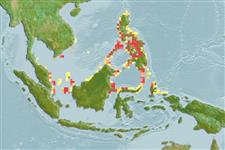
Western Pacific: Philippines.
Taille / Poids / Âge
Maturité: Lm ? range ? - ? cm
Max length : 4.5 cm SL mâle / non sexé; (Ref. 76869)
Description synthétique
Clés d'identification | Morphologie | Morphométrie
Rayons mous dorsaux (Total) : 79 - 85; Rayons mous anaux: 59 - 63; Vertèbres: 42 - 43. This species is distinguished by the following characters: D 79-85, A 59-63, D/A 24-26, V in D 2.2-2.4; vertebrae 12+30-31=42-43; anterior nostril located 1/4 the distance from upper lip to aggregate distance to anterior margin of eye; free pseudoclaspers 2 pairs, outer pseudoclasper wing-shaped with broad base and distally widened supporter without
anterior hook, while the inner pseudoclasper is short, half the length of outer one, with slightly broadened base, distally with two inwardly directed weak spines; cheeks with 4-6 scale rows on upper part and 3 rows on lower part; no upper preopercular pore; otolith compressed, its length to height is 1.9-2.1, pointed anterior and posterior tips, the latter expanded, projecting sharp postdorsal angle, short sulcus, wide with fused colliculi, its centre slightly anterior of centre of otolith, inclined about 10°, otolith length to sulcus length is 2.2-2.4 (Ref. 76869).
Body shape (shape guide): elongated; Cross section: compressed.
Based on collection site, this species is probably adapted to non-reef related rocky inshore environments (Ref. 76869). Cryptic and solitary, inhabitant of reef crevices and caves about 0-4 m (Ref 90102).
Cycle de vie et comportement reproducteur
Maturité | Reproduction | Frai | Œufs | Fécondité | Larves
Schwarzhans, W. and P.R. Møller, 2007. Review of the Dinematichthyini (Teleostei: Bythitidae) of the Indo-west Pacific. Part III. Beaglichthys, Brosmolus, Monothrix and eight new genera with description of 20 new species. The Beagle, Records of the Museums and Art Galleries of the Northern Territory 23:29-110. (Ref. 76869)
Statut dans la liste rouge de l'IUCN (Ref. 130435: Version 2025-2 (Global))
Utilisations par l'homme
Pêcheries: sans intérêt
Outils
Articles particuliers
Télécharger en XML
Sources Internet
Estimations basées sur des modèles
Température préférée (Réf.
123201): 28.4 - 29.2, mean 28.8 °C (based on 199 cells).
Indice de diversité phylogénétique (Réf.
82804): PD
50 = 0.5156 [Uniqueness, from 0.5 = low to 2.0 = high].
Bayesian length-weight: a=0.00389 (0.00180 - 0.00842), b=3.12 (2.94 - 3.30), in cm total length, based on all LWR estimates for this body shape (Ref.
93245).
Niveau trophique (Réf.
69278): 3.2 ±0.5 se; based on size and trophs of closest relatives
Vulnérabilité de la pêche (Ref.
59153): Low vulnerability (10 of 100).
🛈