Classificação / Nomes
Nomes comuns | Sinónimos | Catalog of Fishes(Género, Espécies) | ITIS | CoL | WoRMS | Cloffa
>
Ophidiiformes (Cusk eels) >
Dinematichthyidae (Viviparous brotula)
Etymology: Mascarenichthys: Named in reference to the Mascarene plate, from where most of the specimens observed so far have been obtained; heemstrai: Named for Phillip C. Heemstra, SAIAB, Grahamstown.
Eponymy: Dr Phillip Clarence Heemstra (1941–2019) was an American/South African marine ichthyologist and scientific diver. [...] (Ref. 128868), visit book page.
More on authors: Schwarzhans & Møller.
Ambiente: milieu / zona climática / intervalo de profundidade / gama de distribuição
Ecologia
marinhas bentopelágico; intervalo de profundidade 0 - 11 m (Ref. 76869). Tropical
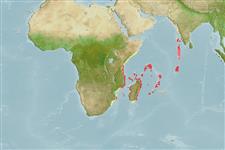
Western Indian Ocean: Seychelles, Cargados Carajos, Mauritius and Reunion, except Agalega Islands.
Tamanho / Peso / Idade
Maturidade: Lm ? range ? - ? cm
Max length : 4.4 cm SL macho/indeterminado; (Ref. 76869); 5.1 cm SL (female)
Descrição breve
Chaves de identificação | Morfologia | Morfometria
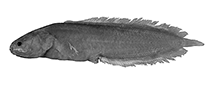
Raios dorsais moles (total) : 62 - 73; Raios anais moles: 46 - 56; Vértebras: 39 - 42. This species is distinguished by the following characters: D 62-73, A 46-56, pectoral fin rays 16-18, D/A 17-25, V in D 1.8-2.1; vertebrae 11+28-30 (rarely 31) = 39-41 (rarely 42); anterior nostril located 1/4-1/5 the distance from upper lip to aggregate distance to anterior margin of eye; moderately large eyes, 1.5-2.7 % SL; 2 pairs of free pseudoclaspers, outer pseudoclasper simple, flap-shaped with pointed tip, broad at base, short, slightly longer than inner pseudoclasper, the inner one is broad, with 3 ridges in anterior, posterior and inward direction and hidden in pocket of wide isthmus (in resting position); 5-7 scale rows on cheek at the upper part and 3-4 rows on lower part; presence of upper preopercular pore present; otolith very elongate, its length to height 2.3-2.5, with sulcus slightly inclined (5°) and colliculi separated, ostium length to cauda length is 3.5-4.5 (Ref. 76869).
Usually observed in catches from the back reef lagoonal and tide pool environments and rare to nearly absent from the main and outer reef environments where Dinematichthys indicus is found (Ref. 76869).
Ciclo de vida e comportamento de acasalamento
Maturidade | Reprodução | Desova | Ovos | Fecundidade | Larvas
Schwarzhans, W. and P.R. Møller, 2007. Review of the Dinematichthyini (Teleostei: Bythitidae) of the Indo-west Pacific. Part III. Beaglichthys, Brosmolus, Monothrix and eight new genera with description of 20 new species. The Beagle, Records of the Museums and Art Galleries of the Northern Territory 23:29-110. (Ref. 76869)
Categoria na Lista Vermelha da IUCN (Ref. 130435: Version 2025-2 (Global))
Utilização humana
Ferramentas
Relatórios especiais
Descarregue XML
Fontes da internet
Estimativas baseadas em modelos
Temperatura preferida (Ref.
123201): 25.4 - 28.9, mean 27.4 °C (based on 322 cells).
Índice de diversidade filogenética (Ref.
82804): PD
50 = 0.6250 [Uniqueness, from 0.5 = low to 2.0 = high].
Bayesian length-weight: a=0.00389 (0.00180 - 0.00842), b=3.12 (2.94 - 3.30), in cm total length, based on all LWR estimates for this body shape (Ref.
93245).
Nível Trófico (Ref.
69278): 3.2 ±0.5 se; based on size and trophs of closest relatives
Vulnerabilidade da pesca (Ref.
59153): Low vulnerability (10 of 100).
🛈