Milieu: milieu / Klimaatzone / Diepte / verspreidingsgebied
Ecologie
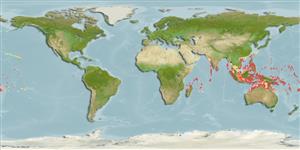
marien rifbewoner; standvastig; diepte 0 - 40 m (Ref. 9710), usually 3 - 20 m (Ref. 37816). Tropical; 31°N - 20°S, 40°E - 148°W (Ref. 5222)
Indo-Pacific: East Africa (but not the Red Sea, Persian Gulf or South Africa) to the Society Islands, north to the Ryukyu Islands, south to northern Australia. Including most islands of the Indian Ocean and that of the west-central Pacific (Ref. 5222). Record from Rodriguez by Heemstra & Randall (1984, Ref. 3153) could not be verified and is probably erroneous (Ref. 33390).
Grootte / Gewicht / Leeftijd
Maturiteit: Lm ? range ? - ? cm
Max length : 24.0 cm TL mannelijk / geslacht onbekend; (Ref. 9710); max. gepubliceerd gewicht: 35.64 g (Ref. 124708)
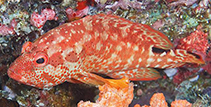
Dorsale stekels (totaal) : 9; Dorsale zachte stralen (totaal) : 13 - 15; Anale stekels: 3; Anale zachte stralen: 9 - 10. Resembles C. urodeta, but always has a distinctive dark saddle on caudal peduncle (Ref. 37816); characterized further by reddish brown head with numerous red-orange or pinkish red spots, extending to pectoral region; mottled pinkish brown body; upper caudal-fin base with large dark brown saddle with smaller saddle just behind; upper part of caudal fin with dark brown streak, less intense streak on lower part; ctenoid scales on body including abdomen; greatest depth of body 2.6-2.9 in SL; rounded caudal fin; pelvic fins, 2.0-2.3 in head length (Ref. 90102).
Body shape (shape guide): fusiform / normal; Cross section: oval.
Occurs in coral-rich areas of lagoon pinnacles, channels, and outer reef slopes. Solitary (Ref. 37816), a secretive species, usually hiding in caves and crevices in the reefs. One of the smallest species of groupers known. Omnivorous with diet composed of fishes and crustaceans; relatively low egg production per individual (Ref. 089707). Minimum depth reported taken from Ref. 128797.
Levenscyclus en paargedrag
Maturiteit | Voortplanting | Paaien | Eieren | Fecunditeit | Larven
Heemstra, P.C. and J.E. Randall, 1993. FAO Species Catalogue. Vol. 16. Groupers of the world (family Serranidae, subfamily Epinephelinae). An annotated and illustrated catalogue of the grouper, rockcod, hind, coral grouper and lyretail species known to date. Rome: FAO. FAO Fish. Synop. 125(16):382 p. (Ref. 5222)
Status op de Rode Lijst van het IUCN (Ref. 130435: Version 2025-2 (Global))
Gevaar voor de mens
Harmless
Gebruik door de mens
Visserij: van minder commercieel belang
Tools
Speciale rapporten
Download XML
Internetbronnen
Schattingen op basis van modellen
Gewenste temperatuur (Ref.
123201): 26.6 - 29, mean 28.1 °C (based on 550 cells).
Fylogenetische diversiteitsindex (Ref.
82804): PD
50 = 0.5000 [Uniqueness, from 0.5 = low to 2.0 = high].
Bayesian length-weight: a=0.01230 (0.00576 - 0.02626), b=3.04 (2.87 - 3.21), in cm total length, based on LWR estimates for this Genus-body shape (Ref.
93245).
Trofisch niveau (Ref.
69278): 4.0 ±0.66 se; based on food items.
Weerstandsvermogen (Ref.
120179): Hoog, minimale populatieverdubbelingstijd minder dan 15 maanden (Preliminary K or Fecundity.).
Kwetsbaarheid van de visserij (Ref.
59153): Low vulnerability (14 of 100).
🛈
Voedingsstoffen (Ref.
124155): Calcium = 66.8 [36.6, 120.8] mg/100g; Iron = 0.566 [0.306, 1.088] mg/100g; Protein = 18.6 [16.8, 20.2] %; Omega3 = 0.176 [0.106, 0.290] g/100g; Selenium = 31.5 [14.7, 56.2] μg/100g; VitaminA = 126 [43, 400] μg/100g; Zinc = 0.979 [0.689, 1.621] mg/100g (wet weight);