Ambiente: milieu / zona climatica / distribuzione batimetrica / gamma di distribuzione
Ecologia
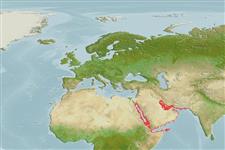
marino associati a barriera corallina; non migratori (Ref. 52884); distribuzione batimetrica 4 - 55 m (Ref. 5222), usually 15 - 20 m (Ref. 89707). Tropical; 33°N - 10°N, 32°E - 66°E (Ref. 5222)
Western Indian Ocean: only from the northern end of the Red Sea to the Persian Gulf and coast of Pakistan. Records from elsewhere are apparently based on misidentifications of other species. Misidentified as Cephalopholis miniatus by Kuronuma & Abe (1986, Ref. 5999) from Kuwait.
Dimensione / Peso / Età
Maturità: Lm ? range ? - ? cm
Max length : 35.0 cm TL maschio/sesso non determinato; (Ref. 5222); common length : 23.0 cm TL maschio/sesso non determinato; (Ref. 5450); Età massima riportata: 26 anni (Ref. 1784)
Breve descrizione
Chiavi di identificazione | Morfologia | Morfometria
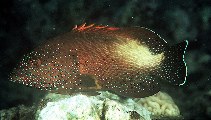
Spine dorsali (totale) : 9; Raggi dorsali molli (totale) : 8 - 10; Spine anali: 3; Raggi anali molli: 8 - 10. distinguished by the following characteristics: body depth 2.7-3.0 in SL; head length 2.4-2.6 in SL; flat interorbital area; rounded preopercle, finely serrate, lower edge fleshy; distinctly convex upper edge of operculum; scaly maxilla, reaching to or somewhat beyond vertical at rear edge of eye; ctenoid body scales, without auxiliary scales (Ref. 089707).
Body shape (shape guide): fusiform / normal; Cross section: oval.
In the Red Sea, it is often found on patchy open reef areas. Feeds diurnally on fishes (64%, mostly pomacentrids) and crustaceans (36%). It is a monogamous species, the pair jointly defends a common territory of up to 62 square m (Ref. 6480). Major threats include overfishing, lack of management and habitat loss (Ref. 089707).
Ciclo vitale e comportamento di accoppiamento
Maturità | Riproduzione | Deposizione | Uova | Fecondità | Larve
Displays obligate monogamy where a one-to-one pair is established irrespective of resource abundance (Ref. 52884).
Heemstra, P.C. and J.E. Randall, 1993. FAO Species Catalogue. Vol. 16. Groupers of the world (family Serranidae, subfamily Epinephelinae). An annotated and illustrated catalogue of the grouper, rockcod, hind, coral grouper and lyretail species known to date. Rome: FAO. FAO Fish. Synop. 125(16):382 p. (Ref. 5222)
Stato della Lista Rossa IUCN (Ref. 130435: Version 2025-2 (Global))
Minaccia per l'uomo
Harmless
Usi umani
Pesca: pesca di sussistenza
Strumenti
Rapporti speciali
Scarica XML
Fonti Internet
Stime basate su modelli
Temperatura preferita (Fonte Biblio.
123201): 25.1 - 29.3, mean 27.3 °C (based on 46 cells).
Indice di diversità filogenetica (Fonte Biblio.
82804): PD
50 = 0.5000 [Uniqueness, from 0.5 = low to 2.0 = high].
Bayesian length-weight: a=0.01230 (0.00576 - 0.02626), b=3.04 (2.87 - 3.21), in cm total length, based on LWR estimates for this Genus-body shape (Ref.
93245).
Livello trofico (Fonte Biblio.
69278): 4.1 ±0.6 se; based on diet studies.
Generation time: 10.0 ( na - na) years. Estimated as median ln(3)/K based on 1
growth studies.
Resilienza (Fonte Biblio.
120179): Basso, tempo minimo di raddoppiamento della popolazione 4.5 - 14 anni (K=0.11).
Vulnerabilità della pesca (Ref.
59153): High vulnerability (58 of 100).
🛈
Vulnerabilità climatica (Ref.
125649): Very high vulnerability (88 of 100).
🛈
Nutrienti (Ref.
124155): Calcium = 43.4 [24.0, 76.6] mg/100g; Iron = 0.5 [0.3, 1.0] mg/100g; Protein = 18.2 [16.4, 19.9] %; Omega3 = 0.154 [0.096, 0.249] g/100g; Selenium = 32.4 [17.4, 57.8] μg/100g; VitaminA = 237 [72, 838] μg/100g; Zinc = 0.929 [0.638, 1.466] mg/100g (wet weight);