>
Cichliformes (Cichlids, convict blennies) >
Cichlidae (Cichlids) > Etroplinae
Etymology: Paretroplus: Name from the Greek 'para' meaning 'on the side of'; in taxonomy it is commonly used in generic names to express similarity or relatedness; in the present case it would mean 'next to Etroplus' (S.Kullander, pers.comm. 3/11); gymnopreopercularis: The specific epithet, gymnopreopercularis, refers to the characteristic asquamate, naked, preopercle in this species (Ref. 78623).
Ambiente: milieu / zona climática / intervalo de profundidade / gama de distribuição
Ecologia
; Água doce pelágico(a,os,as). Tropical
Africa: Mangarahara River, Sofia River basin, in Madagascar (Ref. 78623).
Tamanho / Peso / Idade
Maturidade: Lm ? range ? - ? cm
Max length : 14.7 cm SL macho/indeterminado; (Ref. 78623)
Descrição breve
Chaves de identificação | Morfologia | Morfometria
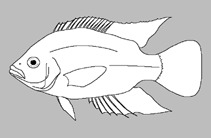
Espinhos dorsais (total) : 17 - 19; Raios dorsais moles (total) : 13 - 15; Espinhos anais: 8 - 10; Raios anais moles: 11 - 13; Vértebras: 32 - 34. Diagnosis: An elongate Paretroplus distinguished from all congeners except P. kieneri by the presence of a blotchy and mottled, orangish-brown to golden-brown, pigmentation pattern, the absence of both vertical bars and a horizontal striping pattern on the flanks, and the presence of a fleshy snout that extends both rostral to the lips and also ventrally to cover a portion of the upper lip (Ref. 78623). Paretroplus gymnopreopercularis is distinguished from P. kieneri by the presence of an asquamate preopercle, vs. fully scaled or scaled except along the ventral margin, and a blunt, strongly convex predorsal profile, vs. pointed; in P. gymnopreopercularis the second lacrimal plate is excluded from the orbit margin owing to contact of the first lacrimal plate and the third infraorbital bone in series, vs. narrow prong of the second lacrimal plate extending into the orbit margin in P. kieneri; in addition, P. kieneri is conspicuously blotchy, mottled, and speckled, and generally exhibits dark gray colouration; in contrast, P. gymnopreopercularis is characterized by a weakly mottled and for the most part uniform chain-link pigmentation pattern, owing to darkly pigmented scale margins, and is never dark gray, but orangish brown to golden brown overall (Ref. 78623).
Body shape (shape guide): fusiform / normal; Cross section: compressed.
Found in shallow, clear rivers; the current is swift, with many areas of small cascades and riffles; substrate is generally rocky, with many exposed boulders, interspersed with areas of sand; Paretroplus gymnopreopercularis appears to be restricted to deeper isolated pools (Ref. 78623).
Ciclo de vida e comportamento de acasalamento
Maturidade | Reprodução | Desova | Ovos | Fecundidade | Larvas
Sparks, J.S., 2008. Phylogeny of the cichlid subfamily Etroplinae and taxonomic revision of the Malagasy cichlid genus Paretroplus (Teleostei: Cichlidae). Bull. Am. Mus. Nat. Hist. 314:1-151. (Ref. 78623)
Categoria na Lista Vermelha da IUCN (Ref. 130435: Version 2025-2 (Global))
Ameaça para o homem
Harmless
Utilização humana
Ferramentas
Relatórios especiais
Descarregue XML
Fontes da internet
Estimativas baseadas em modelos
Índice de diversidade filogenética (Ref.
82804): PD
50 = 0.5001 [Uniqueness, from 0.5 = low to 2.0 = high].
Bayesian length-weight: a=0.01660 (0.00670 - 0.04111), b=2.95 (2.74 - 3.16), in cm total length, based on LWR estimates for this (Sub)family-body shape (Ref.
93245).
Nível Trófico (Ref.
69278): 2.9 ±0.3 se; based on size and trophs of closest relatives
Resiliência (Ref.
120179): Elevada, tempo mínimo de duplicação da população menor que 15 meses (Preliminary K or Fecundity.).
Vulnerabilidade da pesca (Ref.
59153): Low vulnerability (10 of 100).
🛈