>
Cyprinodontiformes (Rivulines, killifishes and live bearers) >
Nothobranchiidae (African rivulines)
Etymology: Nothobranchius: Greek, nothos = false + Greek, brangchia = gill (Ref. 45335); cardinalis: The name cardinalis is in reference to the striking, dominantly red coloration of males; from the Latin cardinalis", meaning principal, chief or essential, from which the ecclesiastical title of cardinal was derived; the name as applied here is an allusion to the blood-red vesture worn by cardinals (Ref. 74420).
Περιβάλλον: περιβάλλον / κλιματική ζώνη / εύρος βάθους / εύρος διανομής
Οικολογία
; Γλυκού νερού Πελαγικό(ά). Tropical
Africa: Mbwemkuru River, Tanzania (Ref. 74420).
Μέγεθος / Βάρος / Ηλικία
Γεννητική Ωρίμανση: Lm ? range ? - ? cm
Max length : 2.7 cm SL αρσενικό/απροσδιόριστο; (Ref. 74420); 2.3 cm SL (female)
Σύντομη περιγραφή
Κλείδες προσδιορισμού | Μορφολογία | Μορφομετρία
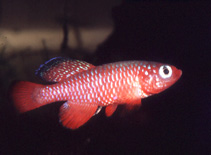
Ραχιαίες άκανθες (συνολικά) : 0; Μαλακές ραχιαίες ακτίνες (συνολικά) : 15 - 16; Εδρικές άκανθες: 0; Μαλακές εδρικές ακτίνες: 13 - 14. Diagnosis: The color pattern of males of Nothobranchius cardinalis and N. rubripinnis have some features that are quite similar: red snout; red pectoral, anal, and caudal fins; and narrow black marginal band to the caudal fin (Ref. 74420). There are, however, some consistent differences: the anal fin of N. rubripinnis has a blue-green background color with red rays and red spots that form irregular transverse bands, especially apparent in the outer, posterior part of the fin, while the anal fin of N. cardinalis is almost a solid red; the pectoral and ventral fins of N. cardinalis are a solid red, whereas in N. rubripinnis these fins are not as intensely coloured and have a translucent quality; the background iridescent blue-green body colour of N. rubripinnis is dominant and the red scale margins are relatively narrow, while in N. cardinalis the red scale margins are much wider, resulting, in some specimens in a dominantly red body; N. rubripinnis always shows a strongly developed, rearward-pointing, chevron pattern on the posterior part of the body, due to the arrangement and slightly increased width of the red scale margins, while in N. cardinalis it is very weakly developed and barely discernible (Ref. 74420). The principal difference in colour pattern of the females of N. cardinalis and N. rubripinnis is the strong and consistent presence of a rearward-pointing chevron pattern on the rear part of the body of N. rubripinnis, which is most strongly developed on the caudal peduncle and is due to enhanced, dark gray scale margins; on females of N. cardinalis the scale margins on the rear part of the body are pale gray and narrow, and may, in some specimens only, form an almost indiscernible chevron pattern on the caudal peduncle (Ref. 74420). The principal differences in colour pattern of males of N. annectens when compared to N. cardinalis are: the main body colour of N. annectens is iridescent blue with golden yellow scale margins; in the rear half of the body there is a strongly developed rearward-pointing chevron pattern caused by red scale margins to every second to fourth row of scales, while the scale margins on N. cardinalis are red, wide, and uniform across the body and, if a chevron pattern is present at all, it is barely discernible; the caudal fin of N. annectens is red with a broad black, vertical, marginal bar, quite different to the relative narrow marginal band shown by N. cardinalis; the pectoral ad ventral fins of N. annectens are pale yellow, whereas on N. cardinalis they are a bright solid red; the anal fin of N. annectens is pale blue, grading out into pale yellow in some populations, while the anal fin of N. cardinalis is almost completely red (Ref. 74420). In contrast to both N. cardinalis and N. rubripinnis, N. annectens lacks the light blue or white margin to the dorsal fin; in N. annectens the dorsal fin margin, if present at all, is always red (Ref. 74420). Although there is some small overlap in the ranges of some characters, males of N. cardinalis differ morphologically from those of N. rubripinnis by: a lesser snout length, 7.1-7.6% of standard length vs. 8.0-9.4%; a lesser snout to eye end length, 17.3% of standard length vs. 17.6-18.9%; a lesser head length, 28.6-32.4% of standard length vs. 31.4-38.3%; a lesser caudal peduncle depth, 13.1-14.3% of standard length vs. 14.2-15.4%; a lesser caudal peduncle length, 19.8-22.9% of standard length vs. 23.1-25.7%; a greater body width, 17.3-19.5% of standard length vs. 12.9-16.7%; a lesser body depth, 30.1-31.6% of standard length vs. 31.1-35.8%; and a greater body length, 67.5-71.4% of standard length vs. 63.5-68.6% (Ref. 74420). Morphological characteristics of the female of N. cardinalis compared to those of N. rubripinnis are less distinctive: a greater body width, 18.7% of standard length vs. 13.2-18.8%; a lesser interorbital width, 7.7% of standard length vs. 8.3-13.5%; a shorter snout to eye end length, 16.4% of standard length vs. 16.5-17.4%; a lesser caudal peduncle depth, 10.8% of standard length vs. 11.6-13.2%; and a shorter anal fin base, 12.6% of standard length vs. 14.1-15.1% (Ref. 74420). The males of N. cardinalis differ in morphology from those of N. annectens by: a greater body width, 17.3% of standard length vs. 14.1-15.0%; a lesser predorsal length, 55.3-57.9% of standard length vs. 56.0-66.7%; a lesser preanal length, 58.2-60.5% of standard length vs. 59.2-66.9%; a lesser number of anal fin rays, 13-14 vs. 15-16; a greater number of scales on the side of the body at the ventral fin position, 12 vs. 11; and a greater number of scales around the caudal peduncle, 16 vs. 14 (Ref. 74420). The morphological characteristics of the female of N. cardinalis compared to those of N. annectens are more distinctive than for the male: a greater body length, 69.0% of standard length vs. 65.3%; a lesser body depth, 28.3% of standard length vs. 28.5-32.3%; a lesser interorbital width, 7.7% of standard length vs. 11.1-12.7%; a lesser snout length, 5.1% of standard length vs. 5.7-7.9%; a greater preanal length, 67.0% of standard length vs. 59.6-67.3%; a greater prepelvic length, 53.7% of standard length vs. 46.8-53.1%; a lesser caudal peduncle depth, 10.8% of standard length vs. 12.1-14.4%; and a lesser number of anal fins rays, 14 vs. 15-16 (Ref. 74420).
Body shape (shape guide): fusiform / normal.
Nothobranchius cardinalis is found in residual, ephemeral pools, which would dry up completely on a seasonal basis; except for some grasses on the banks that hung over into the water, the pool of the type locality was devoid of vegetation of any sort; the substrate comprised a thick layer of very fine, soft, black mud (Ref. 74420). Eggs deposited in the substrate by the adult fish survive therein through the dry season, experiencing numerous phases of development with intervening diapauses; the eggs then hatch at the onset of the following rainy season (Ref. 74420).
Κύκλος ζωής και συμπεριφορά ζευγαρώματος
Γεννητική Ωρίμανση | Αναπαραγωγή | Γεννοβολία | Αβγά | Γονιμότητα | Προνύμφες
Eggs deposited in the substrate by the adult fish survive in the seasonal pool through the dry season, experiencing numerous phases of development with intervening diapauses; the eggs then hatch at the onset of the following rainy season (Ref. 74420).
Watters, B.W., B.J. Cooper and R.H. Wildekamp, 2008. Description of Nothobranchius cardinalis spec. nov. (Cyprinodontiformes: Aplocheilidae), an annual fish from the Mbwemkuru River basin, Tanzania. J. Am. Killifsh Ass. 40(5&6):129-145. (Ref. 74420)
Κατάσταση Κόκκινου Καταλόγου IUCN (Ref. 130435: Version 2025-2 (Global))
Απειλή για τον άνθρωπο
Harmless
Ανθρώπινες χρήσεις
αλιεία: χωρίς ενδιαφέρον
Εργαλεία
Ειδικές εκθέσεις
Λήψη XML
Διαδικτυακές πηγές
Εκτιμήσεις βάσει μοντέλων
Δείκτης φυλογενετικής ποικιλότητας (Αναφ.
82804): PD
50 = 0.5000 [Uniqueness, from 0.5 = low to 2.0 = high].
Bayesian length-weight: a=0.01096 (0.00461 - 0.02608), b=2.94 (2.74 - 3.14), in cm total length, based on LWR estimates for this (Sub)family-body shape (Ref.
93245).
Τροφικό Επίπεδο (Αναφ.
69278): 3.1 ±0.4 se; based on size and trophs of closest relatives
Ευπάθεια στην αλιεία (Ref.
59153): Low vulnerability (10 of 100).
🛈