>
Eupercaria/misc (Various families in series Eupercaria) >
Labridae (Wrasses) > Hypsigenyinae
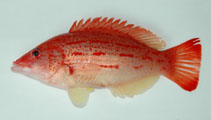
Etymology: Bodianus: Bodianus after Bodiano or Pudiano, from the Portuguese pudor, meaning modesty (Jordan & Evermann, 1896); rubrisos: Name from from the Latin word rubri for red, and the artificial combination of letters sos, referring to the series of red Morse Code-like dots and dashes that make up the
distinctive colour pattern in this species.
Environnement : milieu / zone climatique / profondeur / gamme de distribution
Écologie
marin récifal; profondeur 50 - 103 m (Ref. 90102), usually 50 - 70 m (Ref. 75973). Tropical
Distribution
Territoires | Zones FAO | Écosystèmes | Occurrences | Carte par point | Introductions | Faunafri
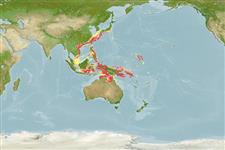
Western Pacific: Japan, Taiwan and Bali, Indonesia.
Taille / Poids / Âge
Maturité: Lm ? range ? - ? cm
Max length : 20.2 cm SL mâle / non sexé; (Ref. 75973)
Photos of individuals taken with maximum size up to about 30 cm SL (Ref. 75973). Oviparous, distinct pairing during breeding (Ref. 205).
Cycle de vie et comportement reproducteur
Maturité | Reproduction | Frai | Œufs | Fécondité | Larves
Oviparous, distinct pairing during breeding (Ref. 205).
Gomon, M.F., 2006. A revision of the labrid fish genus Bodianus with descriptions of eight new species. Rec. Aust. Mus. Suppl. 30:1-133. (Ref. 75973)
Statut dans la liste rouge de l'IUCN (Ref. 130435: Version 2025-2 (Global))
Menace pour l'homme
Harmless
Utilisations par l'homme
Outils
Articles particuliers
Télécharger en XML
Sources Internet
Estimations basées sur des modèles
Température préférée (Réf.
123201): 22.5 - 28.1, mean 27 °C (based on 64 cells).
Indice de diversité phylogénétique (Réf.
82804): PD
50 = 0.5000 [Uniqueness, from 0.5 = low to 2.0 = high].
Bayesian length-weight: a=0.01047 (0.00493 - 0.02225), b=3.08 (2.90 - 3.26), in cm total length, based on LWR estimates for this Genus-body shape (Ref.
93245).
Niveau trophique (Réf.
69278): 3.4 ±0.5 se; based on size and trophs of closest relatives
Résilience (Réf.
120179): Milieu, temps minimum de doublement de population : 1,4 à 4,4 années (Preliminary K or Fecundity.).
Vulnérabilité de la pêche (Ref.
59153): Low vulnerability (15 of 100).
🛈