Pavoraja umbrosa, Dusky skate : fisheries

You can sponsor this page

Pavoraja umbrosa Last, Mallick & Yearsley, 2008

Dusky skate
Waarneming toevoegen in Fish Watcher
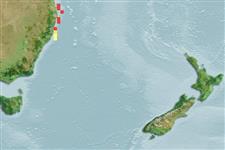
Native range
This map was computer-generated and has not yet been reviewed.
Pavoraja umbrosa   AquaMaps   Data sources: GBIF OBIS
Uploaden van uw Foto's en video's
Afbeeldingen | Google afbeelding
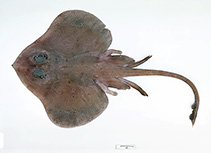
Image of Pavoraja umbrosa (Dusky skate)
Pavoraja umbrosa
Male Afbeelding van Graham, K.

Classificatie / Namen Lokale namen | Synoniemen | Catalog of Fishes(Genus, Soort(en)) | ITIS | CoL | WoRMS | Cloffa

Elasmobranchii (haaien en roggen) (sharks and rays) > Rajiformes (Skates and rays) > Arhynchobatidae (Softnose skates)
Etymology: Pavoraja: Latin, pavo = peacock + Latin, raja, -ae = a sting ray (Raja sp.) (Ref. 45335)umbrosa: Name from Latin 'umbrosus' for shady, refers to the uniform greyish dorsal surface of the disc.
More on authors: Last, Mallick & Yearsley.

Milieu: milieu / Klimaatzone / Diepte / verspreidingsgebied Ecologie

marien bathydemersaal; diepte 360 - 731 m (Ref. 76878). Tropical; 27°S - 33°S, 153°E - 156°E (Ref. 114953)

Verspreiding Gebieden | FAO regio's | Ecosystemen | Voorkomen | Verspreidingskaart | Introducties | Faunafri

Western Pacific: off New South Wales, eastern Australia.

Lengte bij maturiteit / Grootte / Gewicht / Leeftijd

Maturiteit: Lm ?, range 35 - ? cm
Max length : 36.9 cm TL mannelijk / geslacht onbekend; (Ref. 76878)

Biologie     Verklarende woordenlijst (bv. epibenthic)

A demersal species found on upper continental slope. Males reaches maturity at ca. 32-35 cm TL, smallest juvenile 8cm TL. Discarded bycatch of local trawl fisheries (Ref. 114953)

Levenscyclus en paargedrag Maturiteit | Voortplanting | Paaien | Eieren | Fecunditeit | Larven

Hoofdreferentie Upload uw referenties | Referenties | Coördinator : McEachran, John | Medewerkers

Last, P.R., S. Mallick and G.K. Yearsley, 2008. A review of the Australian skate genus Pavoraja Whitley (Rajiformes: Arhynchobatidae). Zootaxa 1812:1-45. (Ref. 76878)

Status op de Rode Lijst van het IUCN (Ref. 130435: Version 2025-2 (Global))

  Niet bedreigd (LC) ; Date assessed: 15 May 2015

CITES

Not Evaluated

CMS (Ref. 116361)

Not Evaluated

Gevaar voor de mens

  Harmless


Gebruik door de mens

Visserij: bycatch
FAO - Publication: search | FishSource |

Meer informatie

Trofische ecologie
Voedsel (prooien)
Dieetsamenstelling
Voedselconsumptie
Voedselrantsoenen
Predatoren
Ecologie
Ecologie
Populatiedynamica
Groeiparameters
Max. leeftijden / maten
Lengte-gewicht rel.
Lengte-lengte rel.
Lengtefrequenties
Massaconversie
Rekrutering
Abundantie
Levenscyclus
Voortplanting
Maturiteit
Rijpheid/kieuwen rel.
Fecunditeit
Paaien
Paaibestanden
Eieren
Ontwikkeling van de eieren
Larven
Larvale populatiedynamiek
Verspreiding
Gebieden
FAO regio's
Ecosystemen
Voorkomen
Introducties
BRUVS - Video's
Anatomie
Kieuwoppervlak
Hersenen
Otoliet
Fysiologie
Lichaamssamenstelling
Voedingsstoffen
Zuurstofverbruik
Type zwemmen
Zwemsnelheid
Visuele pigmenten
Vis geluid
Ziekten en parasieten
Toxiciteit (LC50)
Genetica
genoom
Genetica
Heterozygositeit
Erfelijkheid
Genetische diversiteit
Menselijk gerelateerd
Aquacultuursystemen
Aquacultuurprofielen
Kweeklijnen
Ciguatera gevallen
Postzegels, munten, diversen.
Outreach
Medewerkers
Taxonomie
Lokale namen
Synoniemen
Morfologie
Morfometrie
Afbeeldingen
Referenties
Referenties

Tools

Speciale rapporten

Download XML

Internetbronnen

AFORO (otoliths) | Aquatic Commons | BHL | Cloffa | Websites from users | Bekijk FishWatcher | CISTI | Catalog of Fishes: Genus, Soort(en) | DiscoverLife | ECOTOX | FAO - Publication: search | Faunafri | Fishipedia | Fishtrace | GloBI | Google Books | Google Scholar | Google | IGFA World Record | OneZoom | Open Tree of Life | Otolith Atlas of Taiwan Fishes | PubMed | Reef Life Survey | Socotra Atlas | TreeBase | Tree of Life | Wikipedia: ga naar, zoek | World Records Freshwater Fishing | Zoobank | Zoological Record

Schattingen op basis van modellen

Gewenste temperatuur (Ref. 123201): 6.8 - 12.6, mean 8.3 °C (based on 51 cells).
Fylogenetische diversiteitsindex (Ref. 82804):  PD50 = 0.5156   [Uniqueness, from 0.5 = low to 2.0 = high].
Bayesian length-weight: a=0.00550 (0.00279 - 0.01081), b=3.11 (2.94 - 3.28), in cm total length, based on LWR estimates for this (Sub)family-body shape (Ref. 93245).
Trofisch niveau (Ref. 69278):  3.7   ±0.7 se; based on size and trophs of closest relatives
Weerstandsvermogen (Ref. 120179):  laag, minimale populatieverdubbelingstijd 4,5-14 jaar (Preliminary low fecundity).
Kwetsbaarheid van de visserij (Ref. 59153):  Low to moderate vulnerability (27 of 100). 🛈