>
Blenniiformes (Blennies) >
Blenniidae (Combtooth blennies) > Blenniinae
Etymology: Laiphognathus: Greek, laiphos, -eos = rag, tatter + Greek, gnathos = jaw (Ref. 45335); longispinis: Name from Latin 'longus' for long and 'spina' for spine, refers to the sexually dimorphic elongation of some dorsal spines in males.
Entorno: milieu / zona climática / rango de profundidad / gama de distribución
Ecología
marino demersal; rango de profundidad 5 - 30 m (Ref. 76746). Temperate
Distribución
Territorios | Áreas FAO | Ecosistemas | Ocurrencias, apariciones | Mapa de puntos | Introducciones | Faunafri
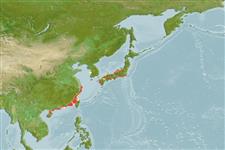
Northwest Pacific: Japan, Taiwan, HongKong.
Tamaño / Peso / Edad
Madurez: Lm ? range ? - ? cm
Max length : 5.1 cm SL macho / no sexado; (Ref. 76746)
Descripción breve
Claves de identificación | Morfología | Morfometría
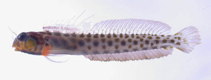
Espinas dorsales (total) : 10 - 12; Radios blandos dorsales (total) : 20 - 23; Espinas anales: 2; Radios blandos anales: 21 - 24; Vértebra: 38 - 40. This species is distinguished and compared from its congener L. multimaculatus by the following characters: in mature males, 3 to 5 of the 6th-10th dorsal spines elongated (vs. none); anterior and posterior nostrils with 3 and 2 cirri, respectively (vs. 2 or 3 on both nostrils); longest posterior nasal cirrus elongate, 68.4-166.7% of orbit diameter (vs. 18.8-100%); in mature males at least, the lower-lip flap is usually separated into anterior and posterior parts (vs. usually continuous); total dorsal-fin rays 31-34 (vs. 29-32); segmented anal-fin rays 21-24 (vs. 19-22); total vertebrae 38-40 (vs. 35-39); spots on cheek absent (vs. small spots present); usually large, dusky brown body spots forming diagonal bands anteriorly (vs. small spots scattered anteriorly); pectoral-fin base with distinct black spot both centrally and dorsally (vs. inconspicuous spots over entire fin base); belly with elongate black spot, from pelvic-fin base to before anus in mature males and females (wider in males) (vs. circular spot just before anus in males only); in males, abdomen becoming reddish (vs. abdomen not reddish); lips never reddish (becoming reddish at least in mature males) (Ref. 76746).
Body shape (shape guide): elongated; Cross section: oval.
Adults are reported to occur on rocky slope area and small individuals are known to occur around sea urchins. Oviparous. Eggs are demersal and adhesive (Ref. 205), and are attached to the substrate via a filamentous, adhesive pad or pedestal (Ref. 94114). They lay eggs in a nest, using holes made by invertebrates on massive corals. The well-developed eggs are taken into the mouth and squeezed by the males and the newly hatched larvae swim out of its mouth. Larvae are planktonic, often found in shallow, coastal waters (Ref. 94114). Spawning season extends from the middle of May to the beginning of October in Kinko Bay, Japan (Ref. 76746).
Ciclo vital y comportamiento de apareamiento
Madurez | Reproducción | Puesta | Huevos | Fecundidad | Larva
Murase, A., 2007. A new species of the bleniid fish, Laiphognathus longispinis (Perciformes: Bleniidae), from southern Japan and Taiwan. Ichthyol. Res. 54:287-296. (Ref. 76746)
Situación en la Lista Roja de la UICN (Ref. 130435: Version 2025-2 (Global))
Amenaza para el ser humano
Harmless
Usos humanos
Herramientas
Informes especiales
Descargar XML
Fuentes de Internet
Estimaciones basadas en modelos
Temperatura preferida (Referencia
123201): 19.2 - 26.9, mean 23.7 °C (based on 258 cells).
Índice de diversidad filogenética (Referencia
82804): PD
50 = 0.7500 [Uniqueness, from 0.5 = low to 2.0 = high].
Bayesian length-weight: a=0.00575 (0.00255 - 0.01297), b=3.06 (2.87 - 3.25), in cm total length, based on LWR estimates for this (Sub)family-body shape (Ref.
93245).
Nivel trófico (Referencia
69278): 3.3 ±0.4 se; based on size and trophs of closest relatives
Resiliencia (Referencia
120179): Alto, población duplicada en un tiempo mínimo inferior a 15 meses (Preliminary K or Fecundity.).
Vulnerabilidad pesquera (Ref.
59153): Low vulnerability (10 of 100).
🛈