Ελασμοβράγχιοι (καρχαρίες και σαλάχια) (sharks and rays) >
Echinorhiniformes (Bramble sharks) >
Echinorhinidae (Bramble sharks)
Etymology: Echinorhinus: echinos (Gr.), spiny or sea urchin, referring to thorn-like denticles (brambles) on body; rhinus, an ancient name for sharks, from rhine (Gr.), rasp, alluding to a shark’s jagged, rasp-like skin (See ETYFish); cookei: In honor of the “distinguished conchologist” Charles Montague Cook, Jr. (1874-1948), Bishop Museum (Honolulu), for his “helpful assistance” with Pietschmann’s work (per Pietschmann 1930) (See ETYFish).
Eponymy: Dr Charles Montague Cooke Jr (1874–1948) was a malacologist at the Bishop Museum, Hawaii and Curator of the snail collection (1902–1948). [...] (Ref. 128868), visit book page.
Περιβάλλον: περιβάλλον / κλιματική ζώνη / εύρος βάθους / εύρος διανομής
Οικολογία
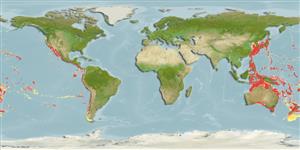
Θαλασσινό(ά) βενθοπελαγικό; εύρος βάθους 11 - 1100 m (Ref. 26346), usually 70 - ? m (Ref. 6871). Subtropical; 47°N - 55°S, 119°E - 68°W (Ref. 54428)
Western Pacific: Japan (Ref. 6871), Taiwan, Palau, Australia (Ref. 6871) and New Zealand. Eastern Pacific: Hawaii, USA, Gulf of California, and from Costa Rica to Peru and Chile (Ref. 13564). Also reported in Nicaragua (Ref. 13613).
Μήκος κατά την πρώτη ωρίμανση / Μέγεθος / Βάρος / Ηλικία
Γεννητική Ωρίμανση: Lm 275.0, range 250 - 300 cm
Max length : 400 cm TL αρσενικό/απροσδιόριστο; (Ref. 247)
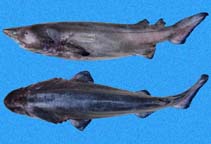
Ραχιαίες άκανθες (συνολικά) : 0; Εδρικές άκανθες: 0; Σπόνδυλοι: 89. The prickly shark Echinorhinus cookei has thorn-like denticles on body which are moderately large (single denticles up to about 4mm in basal diameter in adults), numerous, regularly distributed, with scalloped basal margins, and never fused into compound plates. Grayish brown in color, with black distal fin margins; white around mouth and on ventral surface of snout. Tooth count 21-23/20-22. Total vertebrae 89; precaudal 59. As with the other member of the family Echinorhinidae, it has a relatively short snout and stout body; two small spineless dorsal fins, close together, towards posterior part of body and originating behind pelvic fin origin. No anal fin and subterminal notch on caudal fin. Small spiracles, very short labial furrows and teeth on both jaws alike, with a central oblique bladelike cusps with up to 3 cusplets on each side (absent in juveniles) (Ref. 247, 6871).
Body shape (shape guide): elongated.
A large, sluggish shark occurring on continental and insular shelves and upper slopes (Ref. 247). Feeds on a variety of fishes, other sharks, octopi and squids (Ref. 13564). Ovoviviparous (Ref. 205), with up to 114 in a litter (Ref. 26346).
Presumably ovoviviparous (Ref. 6871) with up to 114 in a litter (Ref. 26346).Distinct pairing with embrace (Ref. 205). Size at birth 40-45 cm. Some males mature by 198 cm; females mature between 250 and 300 cm (Ref. 6871).
Compagno, L.J.V., 1984. FAO Species Catalogue. Vol. 4. Sharks of the world. An annotated and illustrated catalogue of shark species known to date. Part 1 - Hexanchiformes to Lamniformes. FAO Fish. Synop. 125(4/1):1-249. Rome, FAO. (Ref. 247)
Κατάσταση Κόκκινου Καταλόγου IUCN (Ref. 130435: Version 2025-2 (Global))
Απειλή για τον άνθρωπο
Harmless
Ανθρώπινες χρήσεις
αλιεία: περιορισμένης εμπορικότητας
Εργαλεία
Ειδικές εκθέσεις
Λήψη XML
Διαδικτυακές πηγές
Εκτιμήσεις βάσει μοντέλων
Προτιμώμενη θερμοκρασία (Αναφ.
123201): 3.8 - 19.5, mean 12.1 °C (based on 522 cells).
Δείκτης φυλογενετικής ποικιλότητας (Αναφ.
82804): PD
50 = 1.2500 [Uniqueness, from 0.5 = low to 2.0 = high].
Bayesian length-weight: a=0.00363 (0.00138 - 0.00954), b=3.13 (2.90 - 3.36), in cm total length, based on LWR estimates for this (Sub)family-body shape (Ref.
93245).
Τροφικό Επίπεδο (Αναφ.
69278): 4.4 ±0.76 se; based on food items.
Ελαστικότητα (Αναφ.
120179): Χαμηλό, ελάχιστος χρόνος για διπλασιασμό πληθυσμού 4,5 - 14 έτη (Fec assumed to be <100).
Ευπάθεια στην αλιεία (Ref.
59153): Very high vulnerability (90 of 100).
🛈
Θρεπτικά συστατικά (Ref.
124155): Calcium = 6.19 [1.46, 29.11] mg/100g; Iron = 0.439 [0.108, 1.332] mg/100g; Protein = 19.7 [17.9, 21.5] %; Omega3 = 0.244 [0.092, 0.736] g/100g; Selenium = 56.1 [16.6, 203.8] μg/100g; VitaminA = 10 [3, 45] μg/100g; Zinc = 0.382 [0.183, 0.729] mg/100g (wet weight);